Welcome to Flash Pulp, Episode Ninety.
 Tonight we present The Elg Herra: A Blackhall Tale, Part 3 of 6
(Part 1 – Part 2 – Part 3 – Part 4 – Part 5 – Part 6)
[audio:http://traffic.libsyn.com/skinner/FlashPulp090.mp3]
Download MP3
(RSS / iTunes)
This week’s episodes are brought to you by Mr Blog’s Tepid Ride
Keeping one hand on the pulse of America while the other makes off with its wallet.
Find it at http://bmj2k.wordpress.com
Flash Pulp is an experiment in broadcasting fresh pulp stories in the modern age – three to ten minutes of fiction brought to you Monday, Wednesday and Friday evenings.
Tonight, Blackhall finds himself surveying the scene of a death no easier to piece together than the shattered remains of the window from which it originated.
Flash Pulp 090 – The Elg Herra, Part 3 of 6
Written by J.R.D. Skinner
Art and Narration by Opopanax
and Audio produced by Jessica May
Blackhall was the third man in the attic – Commandant Hallson had preempted his arrival only because he’d had the advantage of it being his own home.
The upper-most room, where Ida and Aalbert Bijl had taken lodging, was steepled to follow the line of the roof, and uncomfortable to stand in at its edges. The floor was brimming with a collection of mismatched furniture that had obviously migrated from the Commandant’s private rooms as it became too worn for his own tastes, and, to Blackhall, the space felt too small to hold its appointments.
His head ached from lack of sleep and excess drink.
Somewhere at the periphery of his perception – he could not tell if it emanated from within the room, or from the ground below – came a ticking.
The window had been a single large piece of glass, abutted at its frame by a low seat, upon which Bijl was still reclined so as to look out from behind the carnage of the pane’s remnants. To Thomas’ eye, the remaining fragments about its perimeter appeared as if a collection of misshapen teeth.
“I knew something like this would happen,” Aalbert told the open air beyond, “it was her damnable sleep walking.”
“Excuse me,” said Blackhall, turning on the Commandant, “is there an especially loud clock somewhere in the home?”
“Only the grandfather standing in the front hall, I believe,” Hallson answered, his brow raised in question.
The frontiersman’s abrupt entry into the house had brought a tide of the curious behind him, and, as he focused his attentions down the stairwell, he could hear the commandant’s wife clucking and shushing those at the entrance.
Hallson, noting Thomas’ distraction, turned back to his impassive scrutiny of the widower, his considerations restrained to his own council.
“Somnambulism! Her wanderings have brought my beautiful princess to stumble into her own grave!” Aalbert lamented.
“Your tone falls flat, sir.” Blackhall replied, taking a seat in a well worn armchair and pinching the bridge of his nose in an effort to dispel the throbbing pounding that clouded his mind. The image of a pinwheel he’d had as a child floated up to him from the sleep-deprived depths of his imagination, the edge catching on its base in each revolution: click-click-click.
A heavy tread came from the flight of stairs, and for a moment all three turned to watch the entrance of the voyageur Thomas had encountered at the Pastor’s table. Marco held a kerchiefed bundle in a delicate grip, and all surmised it to be the likely reason the lady of the house had allowed him entrance.
“Bonsoir,” the new entrant said to the gathered. He seemed relieved to see Blackhall on hand, although he turned to speak with the Commandant. “No doubt, sir, you have caught wind of this man’s rantings throughout the length of his stay – his complaints regarding his wife’s nocturnal habits specifically. There may be some truth to it, I can not say, but I tell you this: while below I took a moment to inspect the glass which now wreathes the departed princess, and much of it is covered in prints, as if a confectionery window after the school day’s final bell.”
Peeling back its covering, the Frenchman held out a hooked shard to Hallson, who took it with careful fingers.
A gust blew through the gaping pane, and, to Thomas, carried with it a mental image of Ida, sprawled on the ground below, the bones of her neck pressed hard against her skin, her gaze unseeing, and yet her teeth chattering against the chill of the wind and the approaching grave.
The Commandant held the glass against the light of the single lamp which lit the room, revealing the smudged palm-marks along its surface. All gathered cast their eyes onto it, as if it were a Gypsy’s crystal which might clarify the night’s mysteries.
“She must have been at the window some time, and eventually pressed herself so hard upon the panel that it shattered,” said Hallson, rolling the shard gently as he held it nearly against his nose in inspection.
“There were few obstacles she could not conquer in her unconscious state,” replied Aalbert, “I once encountered her having scaled a writing desk and pawing at the wall behind, as if she might locate a portal to travel beyond it.”
The dance of the light as it played through the remnant only served to drive the spike of pain further into Thomas’ skull, each heartbeat now bringing on a pound which felt just shy of that of a woodsman’s axe.
As it retreated, his mind seemed to throw up every source of ticking he’d encountered as a youth – the click of his father’s pocket watch; the knock of a restless shoe upon the floor of his boyhood classroom during lessons; the tap of a branch against the window of his childhood quarters.
He stood suddenly.
Noting the silver dirk that the princess, Ida, had carried during her surprise visit to his borrowed chamber, Blackhall scooped it up from the small table upon which it had been placed with obvious care.
The rapid elevation had brought further injury to his trampled senses, and yet he forced himself to stagger towards Bijl, still seated at the ragged opening.
“Stop him!” the Commandant ordered, alarmed at the dagger in the man’s hand and the increasing resolve that filled out his strides.
Marco remained stationary.
“Allow me, sir,” Blackhall spoke over his shoulder, in response to Hallson’s alarm, “to present an alternate theory.”
Ignoring the now cowering figure of Aalbert, the frontiersman set his bare, muddy foot upon the cushions of the bench-seat, raising himself to the full height of the pane. He reached behind the drape which framed the fractured aperture and pulled away what, at first glance, appeared to be an empty sewing bobbin.
Staring at the artifact, Thomas spent a moment chewing at his thumbnail, then stepped down to approach the Commandant. As he closed the distance, Hallson noted a glint hovering below the spool.
“A trick I’d long forgotten,” spoke Blackhall, “although common enough on a Yorkshire Mischief Night. Run the finest thread you might locate through a bobbin, then tie it off with a needle hanging at the end of the loop. The slightest draft will set the nearly invisible rig tapping for hours. In my school days we used just the same technique to drive our headmaster nearly mad.”
He was staring down Bijl as he spoke, the dagger in his free hand rising as the Dutchman tensed at his words. He continued.
“Ida spoke of hearing her father’s tapping in her dreams – it is my belief that this beast hoped his wife would follow the sound of his child’s game to her death, and yet, by the looks of the glass you’ve retrieved, she must have spent quite some time against the expanse before her fall. It seems likely that, in the end, it was his own hands which sent her into the night air, and that it was only the immediately pressing eyes of the foot patrol below which stopped him short of reaching up to remove the contraption.”
The widower eyed the door beyond the three men, then, briefly, the window. Finally, he began to weep.
“Yes, I see,” said the Commandant, placing the marred scrap upon the table from which Blackhall had retrieved the Princess’ blade.
“It is my intention to leave in the morning, for I will not sit well through this man’s trial, and it seems incumbent upon me, in her husband’s failure, to carry out the Princess’ final wishes.” He placed the dagger in a deep pocket of his greatcoat. “I ask that you will forgo a christian burial in this instance – my understanding of her people is that their custom might be to lay her body upon a soft bed, in a place of silence, under the blaze of the noon sun. I will not be on hand, however, as my duties compel me to depart post-haste.”
He did not reveal that he little relished the sting another observation of her body would bring him.
The voyageur, who had, until that point, held his tongue, nodded.
“Do you wish company?” he asked, “It was time I set paddle to river anyhow, and I would be more than happy to have another pair of arms to carry my canoe.”
It would be thirty-eight days before the travelers entered the presence of the Moose Lords – as their prisoner.
Flash Pulp is presented by http://skinner.fm. The audio and text formats of Flash Pulp are released under the Canadian Creative Commons Attribution-Noncommercial 2.5 License.

 Acts of architectural daring are one of the few lasting memorials that will keep a name on people’s tongues – art, fashion, entertainment; all of these may pass into history based on the fickle opinion of the public, but, build a two-story bathroom and people will remember you.
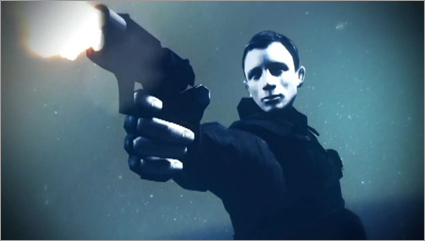
 Pierce Brosnan as James Bond doing the shooty-jumpy-explodey-spy-thing. They turned it into a video game at the time of its release, a classic for the GameCube that I wasted many hours on in my youth.
 This, to me, falls directly in line with the buggering up of Star Wars, and the removal of weapons from E.T.: The Extra-Terrestrial.
 This is a bit of a follow-up post to my recent considerations regarding
  2018: With the landslide election of an aging Carl Weathers, the American
 There seems to be a perennial temptation on the part of civilization – or, at least, western civilization, although I’d guess its a universal human trait – to believe we live in the most morally bankrupt era yet known; that everything is falling apart around us.