Category: Uncategorised

Flash Pulp 095 – Muck: a Blackhall Tale, Part 1 of 1

Flash PulpWelcome to Flash Pulp, Episode Ninety-Five.

Tonight we present Muck: a Blackhall Tale, Part 1 of 1

[audio:http://traffic.libsyn.com/skinner/FlashPulp095.mp3]

Download MP3
(RSS / iTunes)

This week’s episodes are brought to you by Ella’s Words.

Find the poetess’ work here.

Flash Pulp is an experiment in broadcasting fresh pulp stories in the modern age – three to ten minutes of fiction brought to you Monday, Wednesday and Friday evenings.

Tonight we present a brief interlude in Thomas Blackhall’s river travels.

Flash Pulp 095 – Muck: a Blackhall Tale, Part 1 of 1

Written by J.R.D. Skinner
Art and Narration by Opopanax
and Audio produced by Jessica May

Blackhall and his companion, Marco the voyageur, had been paddling and portaging for fifteen days, and, while Thomas had enjoyed much of the Frenchman’s conversation, his patience for the corn whiskey jug that seemed perpetually on hand was growing thin.

The two had pulled the fat-bottomed canoe onto another in the series of muddy banks that demarcated their progress, and, at the emergence of his perennial annoyance, the frontiersman had offered to walk the brush that surrounded the little camp in search of meat that might be roasted.

He’d let himself range far while enjoying the familiar rustling of the wind through untouched forest, and he’d found a security in his surroundings that he’d missed afloat and fighting the fast moving river. Game was sparse, but he’d encountered a mass of huckleberries that had him regretting his lack of a larger container than his palms in which to transport them. It was as he was lost in this consideration, and as his hands pulled berries from shrub to mouth, that he noted a thick line of destruction running through the brush at the patch’s furthest end.

His first thought was that some great bear had trampled through in preparation for its hibernation, but a further consideration of the path left him with an uneasy feeling. It appeared as if some man or animal had moved through the area with little regard for what lay ahead of it: a pine which lay in its course had had its ankle-thick branches snapped at the base, and a great rut of dirt had been agitated in its wake.

Blackhall was swift in putting his Baker rifle into his grip, but it was his sabre, which he’d left at the fire’s edge, that he longed for. He made good time through the darkening woods, despite the fallen autumn leaves protesting loudly at each footfall.

Marco watched Thomas’ entrance into the camp with heavy eyelids, and welcomed the returned with a lift of his whiskey.

“I’ve some work ahead, and it might be dangerous,” said Blackhall, as he hefted his sword. “I’d like your help, but it seems you’ve done yourself under.”

The voyageur cursed the frontiersman, the bottle, the river, the campfire, and his bladder.

“I was drunker than this the night I rode a nag full tilt down the nine mile road, blindfolded.”

He staggered to his feet, his hand going to the buck knife he carried at his belt.

“Où?”

* * *

“It seems ridiculous, but it’s the golem of Prague. It was formed of clay and animated to defend its people from the cruelties of their time – or at least, that’s my best guess, from my readings.” Blackhall now regretted having roused his companion, but there was little he could do. He continued his explanation. “They say it eventually became too aggressive, and was locked in the attic of a synagogue.”

The trail had been simple enough to follow, as the towering form made no effort to alter its course for the sake of ease.

“It just sat there quietly?”

“It is a difficult thing to always hold a loaded pistol in your hand, day in and day out, and not find some need to fire it,” Blackhall replied. “Mayhaps it originally found its way here on some errand, or, feeling the pull that brings all of the world’s phantasms to this final emptiness in their end days, it somehow stowed away. It is impossible to tell. Neither can we say how long it has wandered these rugged lands with little purpose. I would guess that it has been quite some time.”

The thing watched them as they talked, standing as near the river’s edge as it might without risking its never-fired feet. While seeming nearly impervious, it had not moved through the land unscathed, and gouts of its arms and legs had been ripped away by its ill considered path.

“I think the monster wishes to bring an end to itself,” said the voyageur, puffing zealously on one of Thomas’ hand-rolled cigarettes.

Again, Blackhall wished he’d left the man alone with his drink.

“It understands it to be a sin to suicide,” he replied.

Never pausing for thought, the Frenchman moved to the figure and pressed his hands hard upon its shoulders, sending it tumbling backwards into the water.

He’d stumbled back to his jug well before Blackhall had finished watching the remains break up and wash down stream.


Flash Pulp is presented by http://skinner.fm. The audio and text formats of Flash Pulp are released under the Canadian Creative Commons Attribution-Noncommercial 2.5 License.
Holes

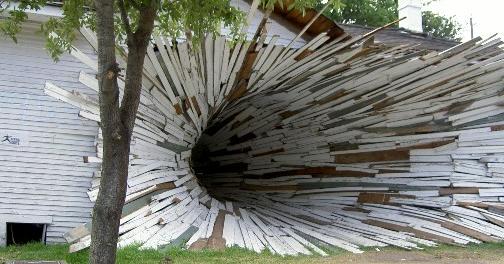
hole in wallAll quotes are from Eyal Weizman’s essay Lethal Theory.

The maneuver conducted by units of the Israeli Defense Forces (IDF) in Nablus in April 2002 was described by its commander, Brigadier General Aviv Kokhavi, as inverse geometry, the reorganization of the urban syntax by means of a series of microtactical actions.

You’re sitting in your living room, terrified by the sound of gunfire that pounds at your walls and seeps through the crack under the door. You’ve gathered your three children into the living room, and hushed them as they hide under a blanket your mother-in-law gave you. The TV is on, but you keep it low, hoping the kids won’t notice the images of the war being conducted around them.

During the battle, soldiers moved within the city across hundred-meter-long “overground-tunnels” carved through a dense and contiguous urban fabric.

The sound of shouting reaches your ears from the apartment next door – you’ve rarely talked to the old lady, she largely keeps to herself, but now you can hear her shrieking and weeping.

The living room wall explodes.

You race to the trio on the couch. Their tears are now also running freely, carving tracks in the dust the blowout has smeared across their faces.

Twelve armed men enter the room through the gap, assault rifles at the ready. With only a perfunctory look, they stomp over the rug you thought was such a great bargain last fall, and head directly into your bedroom.

After a moment another thunderous clap rolls through the apartment, and they make their exit.

Although several thousand soldiers and several hundred Palestinian guerrilla fighters were maneuvering simultaneously in the city, they were so “saturated” within its fabric that very few would have been visible from an aerial perspective at any given moment. Furthermore, soldiers used none of the streets, roads, alleys, or courtyards that constitute the syntax of the city, and none of the external doors, internal stairwells, and windows that constitute the order of buildings, but rather moved horizontally through party walls, and vertically through holes blasted in ceilings and floors.

Toss A Dog On It

http://www.flickr.com/photos/joeltelling/69492277/There was a time when dogs, humanity’s most widely kept animal, were maintained as something more than a couch-warmer. Our historical association is so old, we’re not even entirely sure why we named them what we did:

Due to the archaic structure of the word, the term dog may ultimately derive from the earliest layer of Proto-Indo-European vocabulary, reflecting the role of the dog as the earliest domesticated animal.

wikipedia

Interestingly, we’ve been chummy with canines so long, we (and by we, I mean humanity in general,) actually domesticated them multiple times, independently.

From the Canadian Museum Of Nature:

Genetic evidence suggests that Native Americans and Europeans domesticated dogs independently, and that North American pre-contact dogs were almost completely replaced by dogs that came over on European ships.

[…]

The earliest probable dog remains found in North America are about 8700 to 14 000 years old. These dogs were medium-sized and likely used in hunting. Dogs of this time-period and region are not very common.

  • 10 200 year-old remains were found in Colorado, U.S.A., at the Jones Miller site
  • 11 000 to 14 000 year-old remains were found in Wyoming, U.S.A., at the Agate Basin site
  • 8700 to 9300 year-old remains were found in Wyoming, U.S.A., at the Horner site.

Which, to my mind, leaves a question as to what these original North American dogs must have looked like. Something akin to Huskies is my best guess, but that’s derived entirely from the idea that they looked like the wolves common to the continent.

While some of the uses the mutts were put to were common between all peoples, it seems to me the North American breeds had some novel roles to play.
Dogwich found on Flickr http://www.flickr.com/photos/toronjazul/1084010083/Again from the CMN:

  • they were draft animals in the plains as well as the high Arctic
  • they were bred for wool like sheep and their hair was used to make blankets
  • there were hairless dogs that were used as living hot-water bottles to ease achy joints
  • they were eaten
  • they were important in religion
  • they were buried in graveyards like people.

I love the idea that the people of history might have rubbed a chihuahua-analogue on their shoulder while complaining about a hard-day’s hunt.

That last item does concern me, however – the textbooks may say European disease wiped out millions of Native Americans when the tall ships landed, but I know better: I’ve seen/read Pet Sematary.
Church from Pet Sematary

Flash Pulp 094 – Aspect, Part 1 of 1

Flash PulpWelcome to Flash Pulp, Episode Ninety-Four.

Tonight we present Aspect, Part 1 of 1

[audio:http://traffic.libsyn.com/skinner/FlashPulp094.mp3]

Download MP3
(RSS / iTunes)

This week’s episodes are brought to you by Ella’s Words.

Usually these ads are funny.

Find the poetess’ work here.

Flash Pulp is an experiment in broadcasting fresh pulp stories in the modern age – three to ten minutes of fiction brought to you Monday, Wednesday and Friday evenings.

Tonight we present a suburban haunted house tale, in the classic style.

Flash Pulp 094 – Aspect, Part 1 of 1

Written by J.R.D. Skinner
Art and Narration by Opopanax
and Audio produced by Jessica May

Mike watched as a lone blackbird wheeled below the clouds, riding winds too high to cool the boys roasting in the hot and sticky sun.

For the moment the other two eldest were focused on the youngest, which was a rarity.

“Miller was whispering it to a couple of people, and I heard it while I was on the swings,” said Joe-boy, Mike’s little brother. “The house between Anne Eaton’s and the place with the camping trailer in the driveway is haunted.”

“Ain’t no such friggin’ thing,” said Tucker, Mike’s best friend.

“Hey – I was in a haunted house once, things were flying at my head, my mom got like totally lifted off the ground and stuff, it was crazy!” replied Puggs. Mike could have done without the lanky fourth-grader hanging around, but whenever he opened the door to the outside world there he seemed to be, waiting on the sidewalk.

“Yeah, right. When was that, before or after you and your uncle supposedly caught a UFO on tape?” Tucker had considerably less patience for the braggart.

“Hey, you know I’d love to show you the tape, but my stupid sister recorded over it with a bunch of iCarly episodes.”

“Whatever.”

Mike ceased listlessly spinning his bike pedal backwards.

“Have you got a better suggestion?”

Tucker shrugged. It was at least another hour before lunch.

* * *

The place on the left had opted for paving stones in the driveway and the place on the right had decided the windows overlooking the garage from the second floor would be round instead of square – otherwise, the trio of houses, as could be said about every home in the Whispering Pines suburb, were identical.

Still, the pulled curtains and dying potted flowers that fronted the reputedly haunted residence were enough to stifle Tucker’s skepticism.

“My Dad says he hasn’t seen the guy who owns the place since he moved in,” said Puggs.

“Your Dad says he killed nearly two-hundred people in the Persian Gulf,” replied Tucker.

“He’s gonna show me his ear-necklace when I’m old enough.”

Mike ducked his head back and forth to check the road for elders, then dropped his bike onto the lawn and approached the shining expanse of glass surrounding the front door. The others followed.

Except for a single chair, slightly askew, the entry hall was empty. None of the boys could identify anything further in the dimly-lit space beyond.

“Maybe the guy moved in, then got so depressed about living here that he hung himself,” offered Puggs.

“There’s no one in there. He’s probably at work,” replied Tucker. Despite his bravado, the boy was no longer peering into the darkness.

“Yeah? If you’re so sure, why don’t you go in and check?”

To the surprise of all, Mike tried the handle.

It was locked.

“Miller said he was walking by at night and saw red-glowing eyes upstairs, but when a car drove by, they disappeared.” Joe-boy retreated to the entrance’s step as he spoke.

Mike took another long moment to stare into into the shadows that crowded the lone chair.

“What if we try the magic window?”

The magic window was the name the boys had given a basement frame that had been consistently mis-installed throughout the neighbourhood; the locking mechanism rarely seated properly, and they occasionally used the defect to their advantage when they’d forgotten their home-keys.

The group rounded the side of the house.

“If I start running, its not a ghost, its ‘cause I heard an alarm beep. You run too.” The lead boy bit his lip, considering, then added: “Joe-boy, get on your bike.”

His brother required no convincing.

Standing at the edge of the small pit that was the window well, Mike had a notion, as he often did when he awoke in the middle of the night to use the bathroom, that if he let his legs descend, his ankles would be grasped by some long-nailed horror.

“Uh, I’m going to pull it open from up here, in case someone inside yells.”

Setting himself on his knees, he reached below. Using the friction of his greasy palm against the pane’s cool surface, he moved it first up, then over.

The pinky on his left hand, the hand he’d had pressed firmly against the window, disappeared in a roar surrounded by a halo of shattered glass.

Puggs wet himself.

Tucker stood in a stupor, his eyes wide, his arm extended towards the injury, uselessly.

Spotting the red running down Mike’s wrist, Joe-boy began to cry.

Bike forgotten, the injured youth began to run home, blood and tears leaving a trail behind him on the sidewalk. The others followed like a flock of starlings alighting from a tenuous perch.

* * *

Despite spending the majority of the remainder of the summer grounded and healing from his gunshot wound, Mike was greeted in the fall as a schoolyard hero: the boy who’d discovered the booby traps of the haunted grow-op.


Flash Pulp is presented by http://skinner.fm. The audio and text formats of Flash Pulp are released under the Canadian Creative Commons Attribution-Noncommercial 2.5 License.

Single Source

Frontispiece to Viaggio intorno al mondo fatto dalla nave Inglese il Delfino comandata dal caposqadra Byron (Florence, 1768), the first Italian edition of John Byron’s A Voyage Round the World in His Majesty’s Ship the Dolphin . . .  (London, 1767) [Rare Books Division].Imagine, after the first successful touchdown on the moon, that Neil Armstrong and Buzz Aldrin returned to Earth with tales of moon giants.

“One day we suddenly saw a naked man of giant stature on the shore of the port, dancing, singing, and throwing dust on his head. […] When the giant was in the captain-general’s and our presence he marveled greatly, and made signs with one finger raised upward, believing that we had come from the sky. He was so tall that we reached only to his waist, and he was well proportioned…” – wikipedia

In 1520, the Magellan expedition, having reached South America, may as well have been on the moon – and who would doubt the first people to manage to make it from the Pacific to the Atlantic?

What if the follow-up Apollo missions also made the same claims?

More from the article:

In 1579, Sir Francis Drake’s ship chaplain, Francis Fletcher, wrote about meeting very tall Patagonians.

In the 1590s, Anthonie Knivet claimed he had seen dead bodies 12 feet (3.7 m) long in Patagonia.

Also in the 1590s, William Adams, an Englishman aboard a dutch ship rounding Tiera del Fuego reported a violent encounter between his ship’s crew and unnaturally tall natives.

That would seem to seal the deal – I mean, basketball coaches should be swarming the place like Farmville spam on a Facebook page, right?

The people encountered […] were in all likelihood the Tehuelches, indigenous to the region. Later writers consider the Patagonian giants to have been a hoax, or at least an exaggeration and mis-telling of earlier European accounts of the region. – wikipedia

How much of an exaggeration?

The men’s height ranges from five foot ten to six foot four. The women’s height is on average five foot six but can be close to six foot in some cases. – mnsu.edu‘s Tehuelche page

Say what you will about the robotic exploration of distant planets, but the Mars Pathfinder would never have claimed to have encountered twelve foot tall Martians.

(Unless it did.)

Flash Pulp 093 – The Elg Herra, Part 6 of 6

Welcome to Flash Pulp, Episode Ninety-Three.

Flash PulpTonight we present The Elg Herra: A Blackhall Tale, Part 6 of 6
(Part 1Part 2Part 3Part 4Part 5Part 6)
[audio:http://traffic.libsyn.com/skinner/FlashPulp093.mp3]

Download MP3
(RSS / iTunes)

This week’s episodes are brought to you by MT Starkey Short Stories.

Dark tales of shadowy doings in dimly lit rooms.

To find them, click here.

Flash Pulp is an experiment in broadcasting fresh pulp stories in the modern age – three to ten minutes of fiction brought to you Monday, Wednesday and Friday evenings.

Tonight, Blackhall finally reaches the home of the Moose Lords, where he must complete long standing business.

Flash Pulp 093 – The Elg Herra, Part 6 of 6

Written by J.R.D. Skinner
Art and Narration by Opopanax
and Audio produced by Jessica May

Blackhall’s first view of the longhouses came on the morning of his fourth day riding with the Moose Lords. The evening previous, the small band of travelers had met another mounted patrol, and the Elg Herra had spent a merry night conversing in their own tongue. As dawn broke, they’d kicked the ashes of the fire under, checked the lashings that held Kol’s body in place – now wrapped in the hide of his own saddle bags to stifle his musk – and departed.

Thomas was glad they’d waited till light.

The structures trundled as if massive beetles, the painted symbols on their oblong rooves exposed to the riders, who had approached from the peak of a gentle crest. Great treads marked their passage upon the plain, and, as Blackhall took in the behemoths, he noted that the shortest of the five had no less than sixteen wheels. They moved in an arrowhead shape; the lead and largest wagon was followed by three ranging in a wide row, then close behind those came a mass of black animals. The smallest, and nearest, of the wheelhouses brought up the rear.

“An impressive sight,” he remarked to Asmund.

“A welcome one,” the man replied. “The furthest, the one in the lead, we simply call “The Earl’s House”, although he is but one of its many occupants. The one at center we have named “Night”, as it serves only to allow those who must patrol in the dark hours an opportunity to slumber. On right and left are those we call Dusk and Dawn – they are home to many more Elg Herra. Our shortest house, the one which trails behind, is Relief; it carries lumber, tools, a forge, and the various necessities of maintenance.”

As they overtook the rearmost shadow, Blackhall tightened his coat against the chill wind blown from the spruce trunks that acted as wheel-spokes. Above the grinding complaints of the axle could be heard the occasional creak of shifting wood, familiar to any who had sailed upon a tall ship. However, soon after, both sounds were drowned by the roar of the hooves which gave the conveyance motion. A sea of buffalo moved at its head, the beasts harnessed into an orderly grid and maintained by a half dozen lithe daredevils.

“We call it dancing the squares,” said Asmund. “We value the dancers as we value warriors, and the tales of their bravery are often given equal time in tales of combat. They maintain and direct the beasts, giving them food and water even as we travel, and ensuring the security of both oxen and tack.”

Thomas watched a youth leap from the back of one frothing animal, take three quick steps along a taut leather line, and complete his journey by landing with splayed legs upon the shoulders of another. The boy smiled to see them pass, his fingers still busy working at some unseen kink in the rigging.

As they drew ahead, Blackhall took in the herd. If the grunting rows which pulled Relief had been a sea, then here was an ocean. Thousands more buffalo trampled flat the grasses, their order maintained under the eyes of a wide and moving ring of cow-moose mounted wranglers. Many of the watchers, both men and women, raised a hand in greeting to Asmund and Mord.

It was another half-hour before they overtook the Earl’s house.

* * *

The plan had been straightforward enough. Fifty-seven able bodies, each one the mother or father of a missing child, were sequestered in a single longhouse, in place of the fifty-seven innocents that made up the remainder of the community’s progeny.

“It is my understanding,” Blackhall had told the Earl, “that you contend with a beast known as the Lamia. I have heard her name invoked by mothers as a boogieman, but she was once well known, long ago, as a murderous hag who consumed infants in blind vengeance for the death of her own children, who were supposedly struck down by Hera. You would know her by her face, which unhinges into a monstrous expanse wide enough to insert a child whole.”

His words had been enough to bring the elder leader’s shoulders to sag, and to convince the man of his plan’s merit. It was a necessary trust, as Thomas felt it imperative that none but those involved should know, especially as only Mord and a hand picked second would be on hand to guard the true children, now tucked away in Relief. Blackhall had been sure to implant the defenders’ weapons with what little silver – a nearly universal poison to what the Elg Herra named mist-walkers – the community could turn up, but it had left his trap poorly armed.

The most difficult aspect of the preparation had been the covert modification of the half beds, so that grown forms might appear as if children, and yet still spring readily from the depths of the bedclothes to encounter the monster.

The charade of maintaining a strict watch over infants that were not on hand was wearing, and so it was almost with relief, on the third evening of his vigil, that Thomas finally heard the mid-night click-and-thud of a window being manipulated someway down the darkened hall.

“For Ida!” he bellowed, throwing off the heavy covering he’d laid over his oil lamp. It’s meager light was enough to allow the Elg Herra to leap to their stations, bodily barring each possible exit.

The crone was quick to react, and she immediately began to spider to the nearest shutter on all four of her gout-covered limbs. With a careless toss, she removed one of the window’s guardians, then reared on the stout woman who alone secured the opening.

With a desperate grunt, Thomas threw his saber. The lamia, seeing the inbound weapon, reflexively flinched, even though the sword had been cast on a clumsy arc. The projectile rebounded heavily off of the shutter and clattered to the floor. Blackhall, however, was quick behind his missile; his freed hand had closed immediately upon Ida’s dagger, gifted to him by her brother on the first long night of his duty, and, with his full momentum behind his arm, he plunged the short blade into the crone’s neck. A spurt of clotted, fetid blood ran over the sleeve of his greatcoat, and the hag fell, dead.

Marco, having closed the distance, spotted the outcome, and slapped Thomas’ clean shoulder with a smirk.

Only later would it be noted, with grim eyes, that Hakon could not be found amongst the ranks as the news spread beyond.

* * *

The sweet wine with which they’d ended the conference finally brought a smile to the old man’s face.

Blackhall cleared his throat.

“I can not keep both your daughter’s dagger and my clear conscience. It was Ida’s wish to pass on the blade to one of your people. Perhaps it would be best if it was kept in your care until the next heir is born.”

The Earl’s grin faded as he reached a hand to the jeweled hilt. With a careful hold he set it beside the cup from which he drank. After a moment the man reached forward, once again taking up the long stick with which he’d been stirring the fire. With an eye on the flames, he set to tapping a gentle rhythm upon the iron bowl which held them.

Flash Pulp is presented by http://skinner.fm. The audio and text formats of Flash Pulp are released under the Canadian Creative Commons Attribution-Noncommercial 2.5 License.