Masque of the Red Nap
I apologize, but I’m full of plague. Please check out last night’s story, and I’ll be back tomorrow. (Or later today, but increasingly nonsensically.)
I apologize, but I’m full of plague. Please check out last night’s story, and I’ll be back tomorrow. (Or later today, but increasingly nonsensically.)
Welcome to Flash Pulp, episode one hundred and fifty-four.

Tonight we present, The Haunting of Bilgehammer Manor, Part 1 of 1.
[audio:http://traffic.libsyn.com/skinner/FlashPulp154.mp3]Download MP3
(RSS / iTunes)
This week’s episodes are brought to you by Mr Blog’s Tepid Ride.
To quote the reanimated corpse of Chief Martin Brody: “I think we’re going to need a bigger blog.”
Find out more at http://bmj2k.com!
Flash Pulp is an experiment in broadcasting fresh pulp stories in the modern age – three to ten minutes of fiction brought to you Monday, Wednesday and Friday evenings.
Tonight we present a tale of torment regarding the occupants of the storied acreage of Bilgehammer Manor.
Flash Pulp 154 – The Haunting of Bilgehammer Manor, Part 1 of 1
Written by J.R.D. Skinner
Art and Narration by Opopanax
and Audio produced by Jessica May
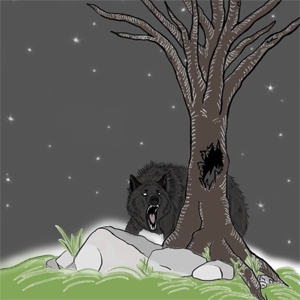 Bilgehammer Manor had once been a sprawling country estate. The vast lawns had long ago been divided and sold as separate plots, and the outbuildings had, in years previous, been lost to fire or weather, but the central house was well maintained, and, despite its reputation, still looked as if it might make an excellent home.
Harvey Finlayson had purchased the property with no concern for its history – his imagination carried him no further than the agent’s very agreeable price.
Now he stood in the main hall, his furnishings piled about him. He clucked, tapping his lips with a pen.
Opening a cupboard, he noted the contents against his list. Satisfied with his findings, he closed the door, but found he’d applied too much force in the process, and sent a harsh echo through the entry area.
He winced, then began to whistle, as if it might cover up his mistake. Sheepishly keeping his eyes locked on his clipboard, he started up the stairs to the second floor. It was at the midpoint of his unobservant journey that he lost his footing.
His back arching, his hands flailed wildly, but never quite reached the banister.
Just as gravity began its inevitable process, ghostly fingers, wearing an ornate wedding band, closed about Harvey’s wrist, slamming his grip into contact with the rail.
“That was close,” Finlayson muttered to himself, never once considering the source of his salvation.
One of the movers pushed through from the porch.
“Hey boss, all this stuff ready to go?”
Unsure if the worker had seen his moment of peril, Harvey felt he needed to retake control of the situation.
“Well, Jerky, it ain’t stayin’ here,” he replied.
Frowning, the man positioned his bright-red dolly under a stack of poorly taped boxes, and wheeled the load onto the veranda.
* * *
A year earlier, when Finlayson had originally arrived, things had been different.
Upon his first evening, the three phantoms of Bilgehammer, the man in the blue jacket, the weeping bride, and headless Amy, had prepared an extensive welcome.
The spectacle had commenced at the stroke of midnight, an hour after Harvey had replaced the remainder of his six-pack in the fridge, and maneuvered up the runner that lead to his bedroom.
Once the man was settled, and the time for startlement seemed optimal, the man in the blue jacket initiated his pacing. Dragging behind him was a translucent duplicate of the chandelier which had collapsed, snuffing his life in that very same hall. To his surprise, the discordant chime of crystal, and the scrape of its metal frame, did nothing to disrupt Finlayson’s wheezing sleep.
A sure tactic for decades, the apparition was at a loss on how to proceed.
It was the weeping bride who next moved to disturb the dreamer. Passing through the wall of his bed chamber, she began to wail as if it were still the day the balcony’s rail had buckled, hanging her by her own veil. At first her efforts also went unnoticed, but, after a stuttering series of gasps punctuated by gusty shrieks, Harvey roused somewhat.
The man had long been a city dweller, however, and too cheap for air conditioning. Never fully coming awake, Finlayson began to shout noises which only vaguely resembled language, but which entirely conveyed his displeasure at the situation.
Embittered at the lack of proper reaction, the woman in white stepped forward, tugging hard at the high-pile of blankets under which the source of her frustration slept. He threw out a cluster of sharp expletives, and yanked the woolly-shell hard over his head, holding it there with a firm grip.
Within seconds he’d returned to snoring.
The gown hovered briefly, then took to the bed. Straddling his blanketed chest, she allowed her eyes to rot into buttery slop, and set her nose against his own. She unleashed a cry which she knew would leave her faint for days to come.
Harvey’s response was delayed, but the tactic was successful in finally making him conscious.
As he looked about the empty room, his gaze contained none of the terror for which the trio hoped.
Releasing a yawn, the interrupted slumberer rose. His kneecaps popped as he stumbled down the flight of stairs and towards the fridge.
He drank greedily from the open can of Old Milwaukee he’d opted to store for the morning, then extinguished the kitchen lights.
The spooks had held back their most potent scare for last.
As Finlayson plodded his way to the second floor, Amy revealed her presence on the landing. The girl stood in her billowing Sunday dress, and carrying her gory head in her hands as she’d been forced to since having it removed by a tumbling pane of glass in the decrepit greenhouse that had once dominated the back-lawn.
“Must be a nightmare, I guess,” Harvey said aloud. Rubbing at his brows, he passed directly through Amy and into his sleeping quarters.
If the night had been bad, however, the spirits found the days considerably worse. Having expended themselves in their exertions, in the sunlight hours they had little recourse but to observe the tromping and snorting that filled whatever corner of the house the new occupant entered. There was no shelter, either, from the clamoring television, which was left to spew unending political commentary at all hours. The one-sided arguments Finlayson conducted with the electronic equipment eventually drove the haunters to spend the majority of their time in the cellar, where at least the sound was reduced to an unintelligible blaring.
Worse still was the damage the clumsy homeowner conducted upon his own property – it seemed no journey to the washroom could pass without some scratch to the formerly grand plaster walls, or some new stain on the plush carpets.
Unnoticed by the opposing side, the nocturnal warfare continued for twenty-nine days, with little effect. It was on the thirtieth that Amy had nearly succeeded in ending the intruder’s life, with an extended leg, as he explored the disused coal chute.
The incident had precipitated a critical conversation between the long-serving companions, and a change in tactics.
* * *
The last item to leave the house was Harvey’s wallet. It had been forgotten on the kitchen counter, but unseen by the living, it had floated from its misplacement, out the front door, and directly through the passenger-side window of the former tenant’s car. It would be unmissable atop the dewy cans which were already warming in the sun.
“I’d rather he not have an excuse to return,” Amy later explained.
A celebratory meeting had been called in the library, which the phantasms found to smell pleasantly of settling dust.
“It would have been nearly worth the pleasure of killing him if he’d spent another afternoon complaining to himself about the current standing of the bloody Red Sox,” spoke the man in the blue jacket, sitting atop his restraining lighting fixture.
“Yes, but imagine if he’d managed to die here?” the bride replied, “I’d rather be moldering than suffer an eternity with that fellow always around complaining.”
The headless girl nodded from her lap. Her hands worked unthinkingly at her braids, as any child’s might upon a beloved doll.
“I’m just glad you thought to simply remain consistent with sabotaging his telly signal – otherwise he might never have gone,” she said.
It was sixteen months of undisturbed death until another resident tried their luck.
Flash Pulp is presented by http://skinner.fm, and is released under the Canadian Creative Commons Attribution-Noncommercial 2.5 License.
Text and audio commentaries can be sent to skinner@skinner.fm, or the voicemail line at (206) 338-2792 – but be aware that it may appear in the FlashCast.
– and thanks to you, for reading. If you enjoyed the story, tell your friends.
http://twitter.com/#!/JRDSkinner/status/58590873163808768
http://twitter.com/#!/JRDSkinner/status/58225836825919488
http://twitter.com/#!/JRDSkinner/status/57831260982218752
http://twitter.com/#!/JRDSkinner/status/57434111014469632
http://twitter.com/#!/JRDSkinner/status/57152787275984896

We’re having some technical issues, which I will avoid cursing about here – I’m going to take the opportunity to give the script another edit, and we’ll have it up early tomorrow, as well as a FlashCast later in the evening.
Part of the beauty of folk legends is their tendency to contain just enough reality to make them seem plausible to a worried mind, while never really properly conveying the facts.
For example, have you heard of the haunting of Gore Orphange?
For over a century visitors to Gore Orphanage Road have reported strange experiences of glowing lights, apparitions and chilling cries of unseen children.
[…]
Orphan children ran away from the home, often wading through the Vermilion River to escape to Vermilion. The children told horrific stories of abuse, neglect and slave labor. The children were said to eat a diet of calves lungs, hog heads and sick cattle – if they were fed at all.
I suspect the popular name for the place was what kept the institution in the public consciousness – although, like many details in such cases, the attribution is incorrect.
Light of Hope, the actual name of the orphanage, was established in 1902 by a religious zealot named Reverend Johann Sprunger. The orphanage was located on Gore Road.
The environment within might have been harsh, but then, so were most, if not all, orphanages of the same period. To be sustained in the realm of folklore, it required something more.
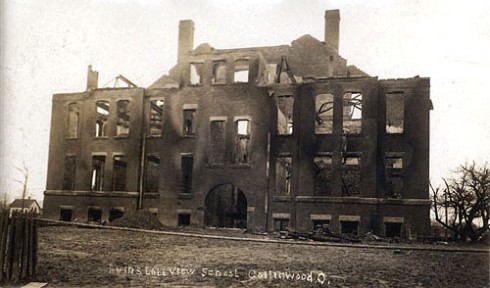
176 elementary school students were burned or trampled to death when they became trapped in a stampede situation and couldn’t escape a fire that was consuming their school. The children began descending down the stairs to the exit after the fire alarm was sounded, but the front stairwell was blocked by flames. According to witnesses, the children at the front broke from the lines and tried “to fight their way back to the floor above, while those who were coming down shoved them mercilessly back into the flames below.” Those who made it to the rear exit found it locked. Outside rescuers unlocked it but found it opened inward, so it was impossible to move against the press of dozens of desperate bodies.
Amongst even the locals, the death of so many little ones became nearly immediately associated with the orphanage on Gore Road, despite the fact that the fire took place forty miles east of the site.
It’s that kind of connection between only vaguely related items which can add up to a generational spook tale.
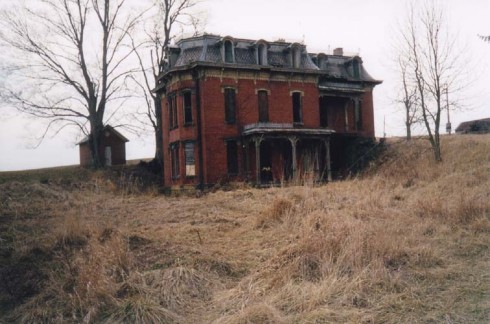 Then there’s this excellent bit of myth regarding the supposed ghosts of “Mudhouse Mansion”.
One legend tells of a government official who lived there after the Civil War and still kept slaves, locking them in one of the outbuildings at night. One night the slave dug his way out, entered the house, and slaughtered the entire family.
A neat little story regarding the balance of power and corruption, but, of course, there’s a problem: Ohio was never a slave state.
Oddly, however, there seems to be a thread between the two locations and their mythologies – properly enforced government regulation is apparently the best preventative measure against hauntings.
Welcome to Flash Pulp, episode one hundred and fifty-three.
Tonight we present, Looming: a Blackhall Tale, Part 1 of 1.
[audio:http://traffic.libsyn.com/skinner/FlashPulp153.mp3]Download MP3
(RSS / iTunes)
This week’s episodes are brought to you by Mr Blog’s Tepid Ride.
Wanna know the truth about Donald Trump’s birth certificate?
Find out more at http://bmj2k.com!
Flash Pulp is an experiment in broadcasting fresh pulp stories in the modern age – three to ten minutes of fiction brought to you Monday, Wednesday and Friday evenings.
We open tonight on a scene many years before the strange burial of Dr. Rasputin Phantasm, as master frontiersman, and student of the occult, Thomas Blackhall, lends an odd sort of assistance to one Declan Callahan.
Flash Pulp 153 – Looming: a Blackhall Tale, Part 1 of 1
Written by J.R.D. Skinner
Art and Narration by Opopanax
and Audio produced by Jessica May
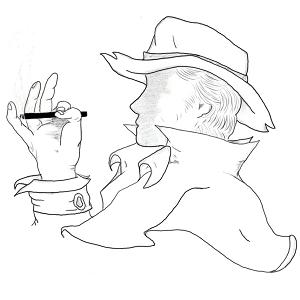 Declan Callahan drove the beast as if he’d caught it mounting his mother. The path was a poor one under the best of conditions, and a week’s rain had burrowed trenches large enough to lose a babe in. Still he pushed, demonstrating little concern for the inevitability of his horse shattering a leg. He nearly slid the animal into a pine copse as the pair rounded the corner which marked the final approach to his shanty, and it was only luck that he survived when the mare’s right-foreleg finally gave way with a moist crackle.
“Yeah fackin’ facker!” the former rider shouted, retaking his feet and paying no more heed to his lost boot than he did his writhing steed.
He achieved the askew door just as his pursuer, sweating under his long, ragged, greatcoat, took the bend.
Callahan, setting his bare and bloody sole against the entrance’s natural inclination to close, grabbed up his musket and slammed home a load, paying half attention to the work of his fingers, and half to the approaching figure of Thomas Blackhall.
The frontiersman had made the entire journey on foot, but two month’s trapping in the area had left him knowledgeable regarding the shortest distance through the underbrush, and he’d been able to make decent time against the forester’s sudden flight from town.
Thomas had been on hand when Doc Brenning had delivered the news. Till the next full moon was the longest he could hope to survive, and the period ought be passed under observation. Callahan would have none of it, and had forcibly removed himself from the parlour which had acted as a temporary medical office.
“How could such a tiny scratch bring down a fella like me?” was his singular declaration before rushing for the exit.
The nag was bound in an endless cycle of attempting to raise itself from the muck, only to stumble under the pain of its mangled limb, and each exertion tore wider the wound caused by the protrusion of splintered leg-bone. As he neared, Blackhall raised his Baker rifle to his shoulder, took aim, and ended the creature’s suffering.
While Thomas paused to reload, Declan took the opportunity to unleash a volley from his own weapon. The range was too great for any accuracy, but, as a declaration of intention, it was highly effective.
Blackhall sprinted a further fifty yards, then, seeing his opponent completing preparations for a second attempt on his life, he sheltered behind a low boulder.
It was a two week wait, with little exchange between the armed men. Despite the occasional effort at conversation, on the part of Thomas, the reply was consistent: “Fack off.”
At most times, neither was quite sure if the other was awake, and, after the first evening, the days crept on in a sleepless, half-conscious molasses.
During this period, Blackhall keenly felt Callahan’s advantage. There was no refuge from the rain, nor the wind, and his nourishment was limited to what small volume of jerky he’d been carrying by happenstance – a greedy afternoon’s worth, at best. At least there was easy access to water, in the ever-replenishing puddles that surrounded his rocky shield.
Frequently, the frontiersman thought he heard the approach of assistance, as surely he could expect from the inhabitants of the town’s clapboard homes, and yet none arrived.
The full moon came on, bright and sagging, and but still Declan stood.
It was obvious, however, that his allotment was short. When the gusts died, Thomas could often hear the man retching, or cursing names that he held no recognition for.
The following afternoon, as the sun rode at its apogee, Callahan lost the final scrap of his humanity.
Bursting forth from the hut with a shambling gait, the rabid man, his mind fully gone, raised high his musket and invested his best effort into running Blackhall down.
At ten feet, Thomas made his peace.
“I’m sorry,” he said, but the broken teeth and blackened eyes seemed to hold little forgiveness.
The shot was a clean one.
Flash Pulp is presented by http://skinner.fm, and is released under the Canadian Creative Commons Attribution-Noncommercial 2.5 License.
Text and audio commentaries can be sent to skinner@skinner.fm, or the voicemail line at (206) 338-2792 – but be aware that it may appear in the FlashCast.
– and thanks to you, for reading. If you enjoyed the story, tell your friends.
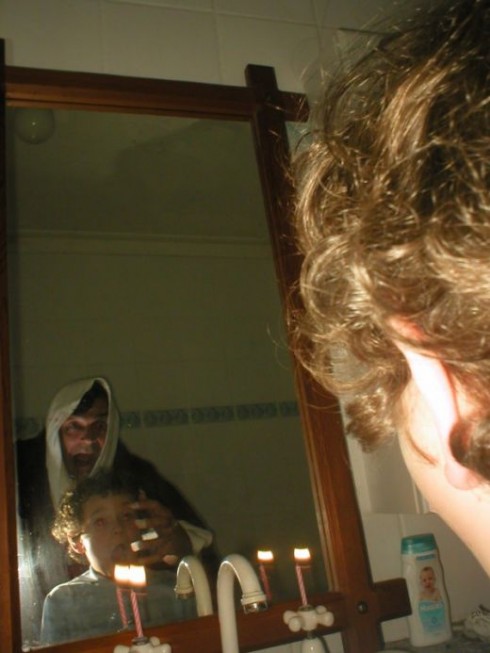 When I was a boy, I was unnerved by graveyards. It wasn’t that I was expecting a ghost to come rambling up from amongst the headstones, it was more the mental image of so many corpses, in various states of decomposition, so close underfoot.
Legend tripping, also known as ostension, is a name recently bestowed by folklorists and anthropologists on an adolescent practice (containing elements of a rite of passage) in which a usually furtive nocturnal pilgrimage is made to a site which is alleged to have been the scene of some tragic, horrific, and possibly supernatural event or haunting.
It’s easy to dismiss weird tales, and such night-time adventures, as simply titilation for the morbidly-curious, but, as I’ve mentioned previously, it’s my contention that such bits of odd ritual play an important role in our social development.
The concept of legend tripping is at least as old as Mark Twain’s 1876 The Adventures of Tom Sawyer, which contains several accounts of adolescents visiting allegedly haunted houses and caves said to be the lairs of criminals. Tom Sawyer is based on lore that was current in Twain’s own boyhood, and by Twain’s time the main features of the ritual were already in place.
It seems obvious to me that this sort of thing was going on well before Twain’s time – likely as long as we’ve been sitting around fires, swapping tales, or coming across caves and copses that, for reasons beyond our understanding, set us on edge.
Despite not understanding the source of their thrill, I believe every tipped gravestone is a rude-finger in the direction of the vandal’s inevitable death, and every climbed step in a haunted house is another proof to the adventurer that the reaper’s grasp is limited, and possibly even defiable.
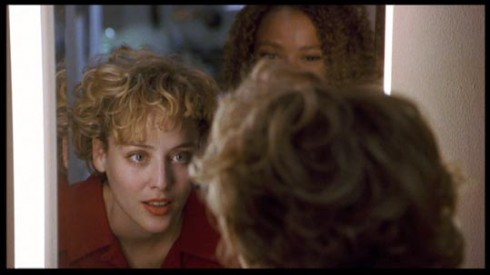
Of course, not all such adventures end in back-patting and story telling, and not all dangers involved are supernatural.
Frances G. Reinehr’s 1989 book [Bloody Mary] tells the true story of long-time Lincoln resident Mary Partington, who became known as “Bloody Mary.” Mary’s old-fashioned dress and her house with no electricity caught the attention of area teenagers, who made a sport out of taunting and harassing her. Mary received her cruel nickname after shooting and killing a youth who attempted to break into her house. She was not charged with a crime on the grounds of self-defense.
What will be interesting to see, in the coming century, is how these legends, and challenges, change.
Just as “The Phantom Hitchhiker” is no longer mounting a carriage, will we one day see something akin to a haunted forum? A blog at which it is said the occasional viewer sees a message from the dead – a message which eventually spells their doom?
Will preteens, tucked into sleeping bags and gathered around the glow of a netbook, one day giggle nervously over a cursed registration page?