Flash Pulp 121 – Spook: a Blackhall Tale, Part 1 of 1

Welcome to Flash Pulp, episode one hundred and twenty-one.

Flash Pulp

Tonight we present, Spook: a Blackhall Tale, Part 1 of 1

[audio:http://traffic.libsyn.com/skinner/FlashPulp121.mp3]Download MP3
(RSS / iTunes)


This week’s episodes are brought to you by the free audio-novella, Boiling Point.

Find out more at http://neilcolquhoun.com


Flash Pulp is an experiment in broadcasting fresh pulp stories in the modern age – three to ten minutes of fiction brought to you Monday, Wednesday and Friday evenings.

Tonight, Thomas Blackhall tells of a haunting from his youth, as he experienced it.


Flash Pulp 121 – Spook: a Blackhall Tale, Part 1 of 1

Written by J.R.D. Skinner
Art and Narration by Opopanax
and Audio produced by Jessica May


Thomas Blackhall collapsed against an aspen at the edge of an open meadow, fatigue drawing him under, even as the noon-day sun blazed overhead. When he awoke, he found himself in the center of a half-circle comprised of a dozen children, all staring at him intently, by the light of the sagging moon.

They demanded to be entertained.

“A spook story!” the shortest shouted.

“No. Not a made up bit about ghosts,” broke in their leader, who’d obviously been nominated by his height, “a living one; a true one.”

With a shrug, Thomas rubbed at his eyes and straightened his posture.

“Listen, and I shall tell you a tale of both the living, and the dead.

“At the age of ten, my father began taking me to see his family in London, once yearly, for my birthday. Until then I’d never experienced the flurry of city streets and markets, and my eye was constantly wandering over those I thought of as greatly privileged to live amongst such wondrous sights. During my first journey, as we dismounted our carriage and walked the length of houses to my Aunt’s, we passed a pregnant beggar woman, her hands extended and her face pious. Without thought, my father produced an assortment of coins and placed them in her upturned palms. She appeared very pleased at his generosity.

“The strangeness began upon the next anniversary of my birthday, when, while retracing our route, the same beggar-ess stood at the corner. On this occasion as well, her womb bulged. Father repeated his act of kindness, seemingly oblivious to the duplication of the previous trip, but, as we moved out of the woman’s hearing, I joggled his elbow.

““She’s still pregnant, a year later!” I said, with all the naivete of a boy of eleven.

“My father, red creeping into his face at the prospect of explaining birthing intervals, changed the subject.”

For a moment, Thomas’ stomach interrupted his telling, responding loudly to its empty state. The children seemed to ripple and waiver before his eyes, and he ran his coat over his brow, wiping sweat from his fevered skin.

With an embarrassed grin, he continued.

“On the third year, Mother was too ill to have us depart, but, on the next, we once again made the expedition. As Pa conducted necessary business, my aunt turned me loose upon the market that held court at the northern edge of her block. With enough jingle in my pocket to keep me in jellied eels for the afternoon, I was left to roam with only the restriction that I should stay within a rigorous set of boundaries, the names of which flew from my mind as quickly as Aunt Charity could recite them.

“As I walked the streets of my approximated travel allowance, I came across a boy of my own age, his father churning away at a portable organ as the lad coaxed a small mutt through a repertoire of antics and athletics. I stood watching as long as my eel-coin held out, but, as the grinder began the third repetition of his barrel, his look was becoming one of expectancy, and my bankroll was exhausted. In truth I’d fallen in love with the white and black entertainer, and, as a boy of fourteen will, I was internally attempting to devise a method by which I might make the dog mine.

“Casting about for an excuse to linger, my mind came upon the oddity of the pregnant beggar, whom I proceeded to ask about.

““Well – there’s no shortage ‘round here of those who can’t keep their knees together, if that’s what you mean to imply, young master – but if its Pregnant Polly you’re looking for, she spends most of her time these days in The Miller’s tap room, just a ways down the lane.” He pointed in its direction.

“I hadn’t expected such a definitive response, and so, with a last longing look at the dancing canine, I felt compelled to follow the provided instructions.

“It was a short walk, and easy to spot Polly through the foggy glass – as there were no other pregnant women in the establishment with tankards of ale held in both hands.

“Funnily enough, it was the dog that held my thoughts in the days after. I didn’t think on the woman again until one night while casting lies into the fire with a gathering of my fellow countrymen. I was homesick, and they were weaving tales of the streets of their youths, stories I took in in a sentimental fashion, at least until the name of Pregnant Polly revived my long dormant memory.

“I can not remember the teller’s name, but I do recall the twisted smirk upon his face as he recounted the woman’s life.

“”She was with bairn at sixteen,” he said, “but it would never arrive, though she looked forever in her final month. At the age of eighteen, still unmarried, and perennially bulging, she was little wanted in her parent’s household, and she was set upon the streets. Unable to make a living, even as a bang-tail , she quickly turned to fleecing tourists in London markets. In truth, who would not find some coin for a beggared mother-to-be? Anyhow, her fame grew such that, when she finally drank herself into an early grave, they cut her open, and inside was a babe: one made of stone. The doctor said it had somehow mummified within her, a situation that was rare, but not unheard of, amongst the pages of his medical texts.”

“So it was that Pregnant Polly was forced to wander the streets, the living ghost of a mother that never was, with the corpse of her child haunting her every step.”

Blackhall fell silent then, awaiting a response from his audience. Without a word, each turned on their own time, and began to wander into the deep brush from whence he’d come. As the last reached the clearing’s edge, he seemed to fade into dissipating moonlight, even as dawn touched the horizon.

It was another hour before Thomas rose, and another day’s travel before he encountered civilization, where he collapsed into a month’s sick bed at his prolonged starvation. He would never be sure if the encounter had been in any way real, or nothing but the byproduct of his hasty consumption of tainted mushrooms during his desperate search for food.


Flash Pulp is presented by http://skinner.fm, and is released under the Canadian Creative Commons Attribution-Noncommercial 2.5 License. Text and audio commentaries can be sent to skinner@skinner.fm, or the voicemail line at (206) 338-2792 – but be aware that it may appear in the FlashCast.

– and thanks to you, for reading. If you enjoyed the story, tell your friends.

Thuggee

Thuggee Cult in The Temple Of DoomHey, remember those crazy cultists from The Temple Of Doom, the ones who lived in a mine somehow secretly attached to the royal palace?

Those fellows were supposed to represent the Thuggee Cult, an actual group once found in India.

According to the Guinness Book of Records the Thuggee cult was responsible for approximately 2,000,000 deaths, while British historian Dr. Mike Dash estimates that they killed 50,000 persons in total, based on his assumption that they only started to exist 150 years before their eradication in the 1830s. – wikipedia

While many religious motivations were ascribed to the Thuggees when the British first began to colonize India, it’s now generally accepted that the group was founded with one goal in mind: the collection of wealth.

It was only later that internal legends, superstition, and the fraternity of a practiced trade, which you’ll find in any large bandit organization – I’m looking at you, Mafia/Yakuza/Goldman Sachs – began to take hold.

While Guinness’ death count is likely exaggerated, the truth of Thuggee operations was not a pleasant one:

When tackling a large group, a Thuggee band might disperse along a route and join a group in stages, concealing their acquaintanceship, such that they could come to outnumber their intended victims by small, non-threatening increments. If the travelers had doubts about any one party, they might confide their worries to another party of the same Thuggee band. The trusted band would thus be the best placed to deal with these members of the caravan at the appropriate time, but might also be able to advise their colleagues to ‘back off’ or otherwise modify their behavior, to allay suspicion. – wikipedia

How do you silently slaughter an entire caravan without raising an alarm?

Elbow grease, team work, and a solid bit of rope.

The timing might be at night or during a rest-break, when the travelers would be busy with chores and when the background cries and noise would mask any sounds of alarm. A quick and quiet method, which left no stains and required no special weapons, was strangulation. This method is particularly associated with Thuggee and led to the Thugs also being referred to as the Phansigars, or “noose-operators”, and simply as “stranglers” by British troops. – wikipedia

Of course, Indy wasn’t the first attempt to replicate the Thuggees on film:

[youtube=http://www.youtube.com/watch?v=4Qc92iI-Sig]

There’s something about the way they would insinuate themselves into the group that I find almost more disturbing than the murders themselves.

Imagine, if you will, riding a bus through the rougher parts of town. You’re nervous, but you take some solace in the smiling faces of the ragged looking folk that mount the metal steps at every stop.

One of the new arrivals even asks you for the time.

Then, three blocks before your own destination, in a deserted end of town, it happens: as the driver is waiting out a red light, half of the vehicle’s occupants rise up, garrotes in hand, and you suddenly feel the choke of wire about your neck.

In moments, and with your personal articles filling their pockets, the smiling vagrants abandon the transport, once again taking up positions in the plexiglass shelters that dot the bus route.
Temple Of Doom Heart Scene

FlashCast 005 – The Family Theremin

FlashCast 005 - The Family Theremin[audio:http://traffic.libsyn.com/skinner/FlashCast005.mp3](Download/iTunes)

Prepare yourself for Patrick Stewart, more Bothersome Things, The Murder Plague, The Collective Detective, and secret theremins.

Mentions this episode:

* * *

If you have comments, questions or suggestions, you can find us at http://skinner.fm, call our voicemail line at (206) 338-2792, or email us text or mp3s to skinner@skinner.fm.

FlashCast is released under the Canadian Creative Commons Attribution-Noncommercial 2.5 License.

We'll Do It Live

Flash Pulp notesHere’s a quick snapshot of the process behind Flash Pulp – this is really how almost every episode begins.

Well, I suppose this is actually step two; step one usually looks like a hastily jotted explanatory sentence, either elsewhere in the notebook, or in my phone.

Events in the proposed story are distributed over the three sections on the left, with random items I need to retain on the right. This is the second run-down I’ve begun for a three-part Ruby Departed tale, which will hopefully be posted the week after next; the first attempt exploded into a thousand weeping paper cuts at the narrative’s climax.

Once I’ve managed to get the three overarching sections pat, I’ll create an identical structure for the trio of acts in each division.

(Also pictured: my notes for tonight’s FC – no peeking.)

Information Corral

FlashCast
I just wanted to duck my head up from scripting to let everyone know that we’ll be posting an episode of FlashCast tonight. Anyone who wants to get in a last minute voicemail should try the line at (206) 338-2792, or email me text/mp3s at skinner@skinner.fm.

If you’d rather add an extra layer to the process, you can also ask me any random questions over at formspring – or on twitter: @jrdskinner.

While I’m at it, I should note that Jessica May loves it when people join the Facebook group.

Buried Treasure

I was finishing up the final draft of last night’s script when Jessica May burst into my office, a battered tin in her hand.

“I just found this. You open it.”

She’d been poking around the basement’s dropped ceiling, an easy hiding spot for the Pacino-loving hooligans who’d occupied the house previously.

Now, she doesn’t mean to cast aspersions on the people who lived here before us, she doesn’t mean to imply they may have forgotten a stash of used heroin needles, and a dead cat, in the ceiling, but –

I opened it.

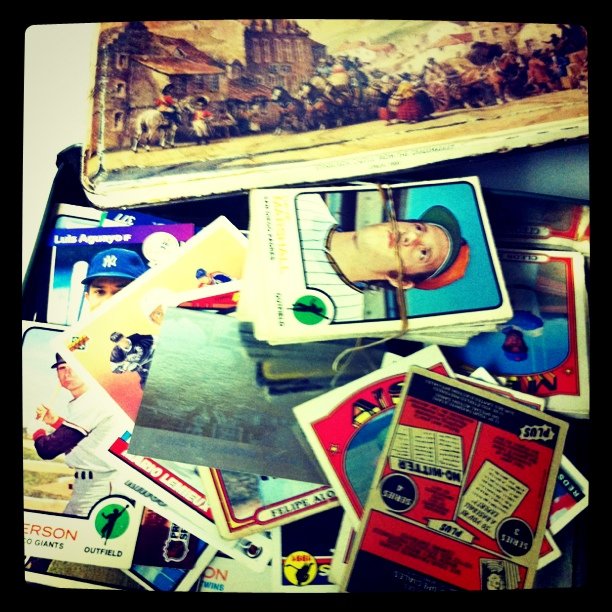
Tin of CardsMostly baseball cards from the early 1970s, with a few ’91/’92 Wayne Gretzky cards on top.

Any suggestions on how to proceed?

Flash Pulp 120 – The Rocket Men, Part 1 of 1

Welcome to Flash Pulp, episode one hundred and twenty.

Flash Pulp

Tonight we present: The Rocket Men, Part 1 of 1

[audio:http://traffic.libsyn.com/skinner/FlashPulp120.mp3]Download MP3
(RSS / iTunes)


This episode is brought to you by Mr Blog’s Tepid Ride.

It’s not him, it’s you.

Find it at http://www.bmj2k.com


Flash Pulp is an experiment in broadcasting fresh pulp stories in the modern age – three to ten minutes of fiction brought to you Monday, Wednesday and Friday evenings.

Tonight, four men engage in their singular obsession.


Flash Pulp 120 – The Rocket Men, Part 1 of 1

Written by J.R.D. Skinner
Art and Narration by Opopanax
and Audio produced by Jessica May


There were four of them: Chris, Paul, George, and Chuck.

Chris was good with math, Paul was a born artist, George’s Dad ran a scrap yard, and Chuck was a genius.

At the age of eight their skills mattered little, as their friendship was forged in a common goal: the destruction of all Martians. While about them their compatriots wasted their recesses imitating the cartoon ninja spectaculars of the day, the four took up the mantle of The Rocket Men, laser toting defenders of Earth. Whatever the weather, the group could be found beating back the imaginary green menace, and keeping the schoolyard safe from alien doom.

Eventually, though, the Martian threat no longer seemed so ominous.

By the age of ten, one thing remained: their combined love of rockets. Each boy had an image of their own custom space vehicle, hand-drawn by Paul, and each was sure that, given enough time and access to George’s father’s sprawling rubbish pile, the group would be able to create a ship capable of carrying them beyond the bonds of gravity, and their mundane lives.

In July of their twelfth year, Chris’ father gathered The Rocket Men into his Chevy Astro and spent two days subjecting the boys to New Country. They didn’t mind, however, as they knew where they were headed: Florida.

On a warm evening, surrounded by hundreds of other enthusiasts of all ages, the former Martian-fighters witnessed the launch of an actual NASA flight – it was a moment they would reminisce on during sleep-overs, while camping, and, one day, with their own children.

During their fourteenth Earth-bound year, Chuck struck upon a plan, and presented it with a smile: they would build a rocket. It took a summer’s worth of saving, and no small number of raids upon George’s familial heap, but a week before entering ninth grade, the boys gathered. They met at dawn, and by the proposed time of launch their sneakers were soaked with the night’s condensation.

They’d created a thing of beauty.

The red cone, entirely decorated by Paul – except the sharpie signatures they’d scrawled along the side – was to be largely driven by powder salvaged from fireworks they’d purchased at a disreputable convenience store. The resulting explosion was a topic of marvel and remorse that would remain a point of contention amongst the boys for months.

At the sight of the destruction of their labour, the youths had nearly fallen into despair, and that might have been the last of The Rocket Men had it not been for an outburst from Chuck. The prodigy had always suffered through any defeat or disappointment in the same way: wild laughter. Within moments the entire group had taken his lead and tumbled to the ground, their jaws aching with mirth.

When they finally collected themselves, each one scooped up a shard of peeled metal as a reminder. As Chris and Chuck spent long hours arguing the math of the thing, Paul and George would often fill the time by staring longingly at their keepsake fragments.

All were agreed that someday they would make another attempt.

At sixteen, the group took up model rocketry. It never scratched the itch that building something entirely of their own design had infected them with, but each success was a spectacle that drew them together, even as life seemed to be pulling them apart.

They still talked of constructing a flight from scratch, but privately they could feel the chance slipping away as college loomed.

At eighteen, Chris left to become a physicist, Paul departed for art school, George joined his father amongst the garbage, and Chuck received a scholarship in aerospace engineering.

Letters, phone calls, and emails, were exchanged, but, in time, they petered to a halt. A wedding in their thirtieth year marked the last meeting of The Rocket Men for over a decade, despite the tipsy promises of renewed communication that each had made during the reception.

Eleven years later the silence between them was broken, and it was Chuck who once again brought them together.

The plans he’d prepared were complex – well beyond the model rockets they’d built in their high school days – but he’d also fitted the bill, and provided plenty of suggestions on where to locate any answers they might not have.

After six months of weekend effort, The Rocket Men once again found themselves in the dewy grass of a breaking summer morning, now accompanied by Chuck’s wife, Cynthia, who’d transmitted her cancerous husband’s designs and request.

It wasn’t a massive ship, it could really only manage to lift the dead man’s ashes, but, still, the grinning maniac of their youth had had the last laugh: he would be the first amongst them to reach orbit.


Flash Pulp is presented by http://skinner.fm, and is released under the Canadian Creative Commons Attribution-Noncommercial 2.5 License. Text and audio commentaries can be sent to skinner@skinner.fm, or the voicemail line at (206) 338-2792 – but be aware that it may appear in the FlashCast.

– and thanks to you, for reading. If you enjoyed the story, tell your friends.

An Argument For The Undead

Zombies from Night Of The Living DeadA while ago, fashion guru and fantastic lady, Jes Lacasse, was asking around regarding the staying power of the zombie genre, and I promised a post explaining why the shambling undead can still carry a story, despite their recent over-exposure.

However, I must note that I’m no zombie academic – I’m just a life-long horror fan, and occasional writer of post-apocalyptic walking-rotter stories.

Before we can shoot straight to the dead folks, we’ve got to take a walk back in time.
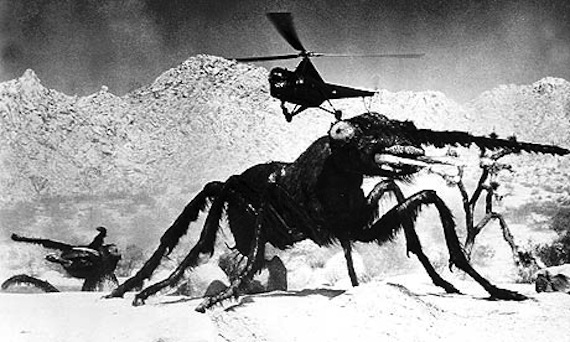
Attack of the 50 Foot Woman PosterAfter the second world war, horror as a genre was right out. People had seen far too much killing in real life to want to head into a theater and watch some more, which is why most ’50s horror films are really science fiction thrillers revolving around either giant insects, (or, sometimes, people,) or aliens.Giant Ant From ThemThis started to change as Vincent Price’s star began to rise, and as the British studio, Hammer Films, began to move away from science fiction and into scarier fare, but the genre as a whole didn’t really return in full force until the 1960s – just long enough for teenagers without combat experience to begin paying for their own theater admissions.
I mention it because, in all eras, horror tends to be a reflection of the concerns of the period in which it is made. Worried about the advances in nuclear science? Make a giant bug movie. Concerned about our race to space? Bring on the aliens. Fretting about your child’s morality? Have their naughty behaviour cut short by an axe-wielding maniac.
Jason Voorhees, lifeguardNo sub-genre is more complex in its presentation of these narratives than that of the reanimated corpse.
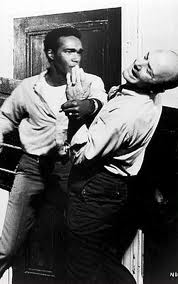
The modern idea of zombies was defined in the late 1960s, amidst race riots, Vietnam, and white flight, and I’d be hard pressed to name another film that demonstrates that more clearly than the original Night Of The Living Dead, the progenitor of all modern shambler flicks.

Warning: here there be spoilers.
When Harry Met Ben, 1968Night Of The Living Dead is really a movie about a black guy and a young woman taking the brunt of an unyielding invasion of aggression, while a rich white fellow hides his family in the basement, along with a couple of yokels – representing the working class – who kind of realize they should be helping the people upstairs, but are pretty comfortable just taking orders from the guy with the money. Eventually the lack of unity causes the whole situation to collapse.
When Harry Met Ben, 1990You don’t see that kind of commentary in a vampire film.
It isn’t just NOTLD either, it’s my contention that any zombie story can’t help but be a tale about society.

Dawn Of The Dead is a film about the vapid woes of consumerism, and Day Of The Dead actually probably failed under the weight of its science vs military/knowledge vs authority political message.
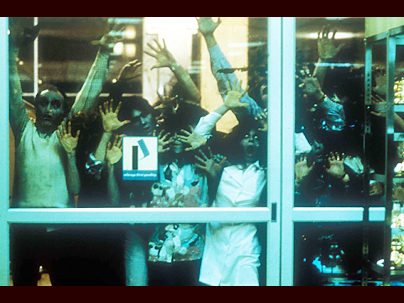
Dawn Of The Dead (1978) Shoppers
Even back so far as 1932’s White Zombie, the pattern holds: a white landholder in Haiti uses black zombie slaves to run his plantation, only to be stopped by a modern fellow who believes the situation unjust – well, and wants his girlfriend back.

Return Of The Living Dead is the reflection of the 1980s mentality that only the kids of the day knew what was going on, and that death can come cheap and easy in an age overshadowed with unstoppable (read: nuclear) annihilation.

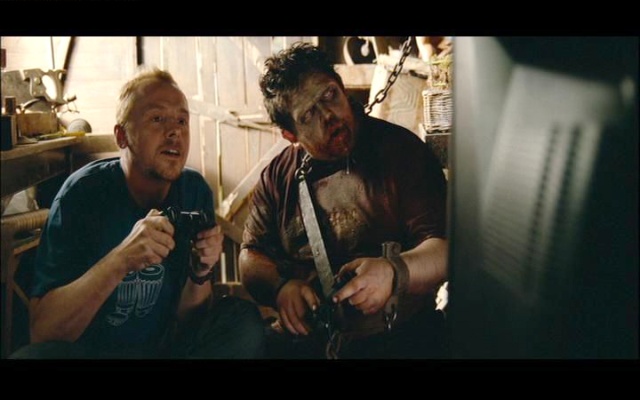
The more modern Shaun Of The Dead, something of a comedy, is a tale about people expending their lives going to work, sitting around, drinking, and playing video games.Shaun Of The Dead
As a final example, Jonathan Coulton‘s song, Re: Your Brains, is a play on the vagaries of modern office life, small talk, and the types of requests we receive that are really demands.

[youtube=http://www.youtube.com/watch?v=cOlznuyPOeM]

I’ll stop there, but the pattern is endless, because zombies are the classic “they are us” enemy. The critical function of a zombie isn’t to be shot in the head, it’s to act as a crucible to force the leading characters into the hard decisions they avoid in their normal lives.
Shaun rides the bus
As a side note: this is also why I draw the line at fast zombies. Slow zombies force a mentality beyond just cheap scares. Something running at you fast can be anything – a dog, a dead guy, a four-hundred pound rabid orangutan – it’s the speed and mass that makes it scary, and the enforced space for a greater message is lost.
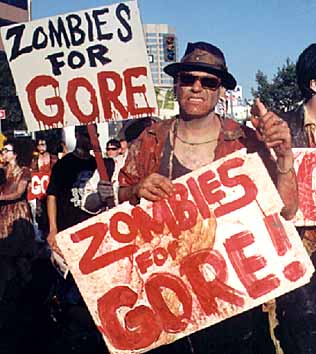
Zombies for Gore from http://la.cacophony.org/zombiegore.htmlWhat I’m getting at is, the undead remain a strong contender in the pop culture space because there are as many variations in the significance of their situations as there are in the situations, big or small, that we face in our daily lives.

Nicolas Cage, Educator

To kick off Friday, I wanted to post up this bit from Nic Cage’s new children’s show:
[youtube=http://www.youtube.com/watch?v=68BjP5f0ccE]
(OK, maybe not.)

I do find it funny that this twenty-five second clip demonstrates nearly the entire range of Cage’s acting – except, of course, his sad/intense/introspective face, pictured below.
Nic Cage's sad/intense/introspective face.