FP225 – The Angler: a Blackhall Tale, Part 1 of 1
Welcome to Flash Pulp, episode two hundred and twenty five.
 Tonight we present, The Angler: a Blackhall Tale, Part 1 of 1.
[audio:http://traffic.libsyn.com/skinner/FlashPulp225.mp3]Download MP3
(RSS / iTunes)
This week’s episodes are brought to you by Nutty Bites.
Flash Pulp is an experiment in broadcasting fresh pulp stories in the modern age – three to ten minutes of fiction brought to you Monday, Wednesday and Friday evenings.
Tonight, Thomas Blackhall, student of the occult and master frontiersman, awaits the arrival of a meal.
The Angler: a Blackhall Tale, Part 1 of 1
Written by J.R.D. Skinner & Opopanax
Art and Narration by Opopanax
and Audio produced by Jessica May
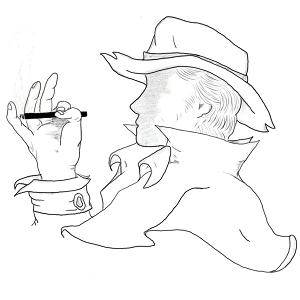 At the edge of White Creek, Miser Jenkins had taken up a hushed watch, with rod in hand. He’d spent the morning ignoring the fat flakes that drifted to the ground about him, as he knew that, despite the cold, the bass were just as in search of a meal as he.
The fisherman had acquired his stingy condition honestly, having had to save coin, and bread crusts, to pay for his passage to York. Thereafter, he’d simply never forgotten the habit, and his half-full wicker creel stood as testament to his persistence.
While allowing the fast moving stream to dance his bait, the old man had lost himself in consideration of the distances he’d come, but a fresh nibble at his line awoke him from his ruminations.
Patience, however, was Jenkins’ particular talent, and he held his position without excitement.
The sound of the flow running over the brook’s rocky protrusions remained steady, and a crow let his spectatorship be known from a nearby branch. Unflustered by the audience, and with only the slightest movement of his practiced hands, the miser gave his dead worm a tempting imitation life.
Finally, as an extravagant mound of snowy fluff touched upon the water’s surface and collapsed, the rod bent strongly, and the trap was sprung.
Seconds later Jenkins was triumphantly removing a wriggling specimen from his hook, and noting how, although no creek-catch is ever a feast in itself, this trophy seemed especially plump.
While still smiling, the victor turned and spotted a naked boy, some hundred feet away, staring downstream from the far bank. The newcomer’s eyes were wide, and his mouth down-turned.
The bald trees did nothing to hide the child’s tears from the crisp noonday sun.
“What ails you?” asked the fisherman.
The youth took a step backwards, setting a birch between himself and his interrogator.
Miser began a slow approach, speaking in reassuring tones, and gathering the opinion that the stripling was likely one of the Ojibwa encamped in the area. He did wonder, though, that he did not recognize the face, as he was on good terms with the locals of the tribe.
Then the weeping boy disappeared behind his thin barricade.
Curious, Jenkins bridged the stream at a point where three broad stones provided a hopping passage, and pressed on.
Upon arriving, he inspected the area, but could see no trace of the naked juvenile. The fallen leaves appeared undisturbed, and the water’s murmur covered any noises of flight.
Turning towards his basket, however, Miser was brought up short.
The boy was there, with both his hands wrapped around the satchel which contained Jenkins’ intended dinner. The angler once again set himself to hailing the stranger, but the lad’s pale bare-feet carried him rapidly into the woods.
“Hey now!” shouted Jenkins, his stride picking up fervency.
As he reached the site of his vigil, Miser caught a glimpse of bare shoulders ducking beyond a distant pine.
He gave chase.
The barren branches provided Jenkins visibility, but the grasping fingers also held back his thick coat, and snatched at his woolen hat. Twice he feared he’d lost the trail – on the first his transgressor’s nerve had broken, and he’d bolted from his hiding place beneath an evergreen, and, on the other, he’d simply caught sight of a leg as it topped a stone-pile.
Even in his indignant anger, as he climbed the second obstacle, Jenkins spared a thought for the pains the boy must be suffering, rag-less and under such duress. Between huffing exhalations, he resolved to share some of his bounty – once he’d beaten an apology out of the miscreant.
“Return my supper, you cheat,” shouted Jenkins, to no response.
Achieving the short summit, Miser was presented with an unexpected scene: The mouth of a cave was gaping some twenty feet away, and, at the midpoint between himself and the maw, a large dead stag lay rotting.
A pair of cedars stood as dying sentinels beside the opening, and, though it was expected that the season would be harsh for the timber, there was a discordance in the strained angles of their limbs which gave him pause.
Yet, though the shadowy cavern provided no better welcome, Jenkins was intent on his prize, and it stood as the likely hiding place upon the small plateau. He moved forward with a reluctant boot, but, before its twin could follow, the decaying deer appeared to burst.
The stranger rising from the gore-laden flap of animal hide was not what caused the majority of Miser’s concern, however – it was the lit dynamite, wrapped with gleaming wire, in the interloper’s grasp.
The rocky hollow gave a booming wail, to which the explosive-wielding man responded with a strong arm.
Even as the payload passed between the skewed cedars, the wide entrance shuttered itself, as if stone-lips slamming shut.
Before Miser could consider retreat, there was a rumble, then silence.
“I apologize for the surprise,” said the bomber, “I am Thomas Blackhall.”
“Jenkins, but you’ll pardon if I don’t shake your hand at the meeting, you seem to have some venison affixed to your forearm.”
“Apologies, as well, for my appearance. I’ve been lying within the foul beast for the last three nights, awaiting my opportunity.”
“Opportunity?”
“Aye,” replied Thomas, as he scraped rancid meat from his sleeve. “The hill fiend was wary, and only allowed itself to yawn wide as you approached. It had forgotten about my presence, I feel sure, but such creatures don’t grind their way across the landscape for millenia without some cunning. Whatever the case, the scattering of the binding about my munition ended its slow hunt – silver is noxious to the things.”
Jenkins found a stone, a good ways apart from the deer carcass, and took a seat.
“It is too much for me, sir,” he said, “and I must confess I do not quite understand.”
Thomas nodded.
“If you’d entered the cave, what you considered the roof would have rapidly descended, leaving you little more than a paste filling the gaps and crevices about the floor. Then, as the soil does, it would consume your remains over time, as your body naturally crumbled. Such is nearly what happened to my place of shelter. Although the stag did manage to escape, the ripping loss of his rear limbs was too much, and it was dead before long.”
“- but what of the boy?” asked Miser, with a rasp in his tone.
Blackhall retrieved a water-tight pouch from within his pockets, and began pinching tobacco into a fine rectangle of paper.
“A phantasm wrought by arcane instinct,” he replied. “For the stag it was a doe, for you, a thief; the right lure for the job. Return to your lost goods, they likely remain where you believe you left them.”
“What fiendish cunning!”
“It is interesting how often the need for sustenance teaches cleverness. I rather suspect it is the case that, in truth, it had no more intelligence than an arachnid spinning a web, and held no more malice than an angler upon a stream.”
Flash Pulp is presented by http://skinner.fm, and is released under the Canadian Creative Commons Attribution-Noncommercial 2.5 License.
Freesound.org credits:
Text and audio commentaries can be sent to skinner@skinner.fm, or the voicemail line at (206) 338-2792 – but be aware that it may appear in the FlashCast.
– and thanks to you, for reading. If you enjoyed the story, tell your friends.
 The bottomless nature of the elder Smith’s contacts had never ceased to amaze his son. The old man had assured him, at length, of the skill of the bush pilot, who’d introduced herself as Molly. It was not her abilities, however, that troubled the detective – it was his father’s insinuation about finding a nice girl and settling down.
 Mulligan’s troubles began when the first courier found him at the entrance to his preferred 7-Eleven. The helmeted youth had stopped him short on the curb before the PI had had time to take the opening sip of his slurpee.
 By the age of fifteen, Mila Da Silva’s learning impediment had left her in a classroom surrounded by children half her age. The rural school she’d been attending had no budget to allocate to her special needs, and her parents had little money to invest in giving her a better education.
 Smith had returned to his client’s house, on the west-side of Capital City, to find a black sedan parked on the paved lawn. Although Mulligan expected the carefully generic vehicle, he hadn’t anticipated a sudden thunderstorm, and slowed traffic had cost him the opportunity to intercept the stranger before they’d entered the home.
 Mulligan had hated high school. Worse still, by having never left Capital City, he had found himself once again in the same halls he’d walked as a student.
 The house sat slightly to the right of the center of its block, and was flanked on either side by nearly identical replicas of its brick facade and wooden porch. The neighbourhood, on the west-side of Capital City, had been claimed by the somberly dressed office dwellers of the downtown core, and many of the small front yards had been smothered in pavement, to make space for extra parking.
 Linwood’s claim that he was from some safe beyond nearly brought tears to my eyes, but there’s a voice that lurks at the rear of your skull after you’ve spent any time surviving the deadly overtures of a countryside full of lunatics – a sharp little bugger of a thing that’s eager to kick over your daydreams and pierce your hopes.
 It’s an odd thing to introduce yourself to your neighbour when you are both miles from home, and you can’t be entirely sure they haven’t murdered someone. Worse still, it was soon obvious that Mr. Baldy, who presented himself as Virgil Gratey when I admitted I couldn’t recall his proper name, knew much more about my affairs than I knew of his.
 The McKean’s lived in a two story house at the furthest edge of Massawa Acres, a planned suburb still in the beginning throes of construction. Doug, the father, had bought early, with the thought that land prices would only rise as development continued. When he’d announced his plan, his family had done little more than nod their agreement before returning to their individual pursuits.