Category: Uncategorised

Flash Pulp 113 – The Chase: a Blackhall Tale, Part 2 of 3

Welcome to Flash Pulp, episode one hundred and thirteen.

Flash Pulp

Tonight we present The Chase: a Blackhall Tale, Part 2 of 3
(Part 1Part 2Part 3)
[audio:http://traffic.libsyn.com/skinner/FlashPulp113.mp3]Download MP3
(RSS / iTunes)


This episode is brought to you by the Bothersome Things podcast.

Come for the unsettling news, stay for the disturbing banter.

Find them at BothersomeThings.com, or find them on iTunes.


Flash Pulp is an experiment in broadcasting fresh pulp stories in the modern age – three to ten minutes of fiction brought to you Monday, Wednesday and Friday evenings.

Tonight, we find Thomas Blackhall ensnared in a trap formed of duty and the hungry mouths of curs.


Flash Pulp 113 – The Chase: a Blackhall Tale, Part 2 of 3

Written by J.R.D. Skinner
Art and Narration by Opopanax
and Audio produced by Jessica May


Blackhall expected panic, but instead it seemed it was only he and Marco who had little idea on how to conduct themselves during the attack.

The call of the war horns had turned hundreds of dogs upon the caravan, but within moments the flood was met by the first of the defenders: a group of three youths, each on a cow moose, drove hard against the deluge, their long clubs swinging heavily. The ragged gray and brown mob made short meals of the lot – the furry-tide seemed to simply rise and overtake them – but this slowing was enough to bring another twenty riders forward at a gallop, and the strengthening line brought the horde to a brief halt. Even then – while the center of the pack held at the sight of the fresh guardians, the pooling edges began to surround the group, so that soon they too would be drowned.

Thomas moved swiftly to the ladder, to begin the long run to his Baker rifle, stored alongside his nightclothes, but he knew it would be for not – that by the time it was in his hand, his friends amongst the Elg Herra would be laying bloody and half consumed by wolfen-snouts.

His re-entry into the home was brought short, however, by spotting the spindly-limbed Mathus, clambering, gargoyle-like, to the roof of the wagon nearest the conflict. His gray hair had taken to the wind, and Thomas could see the man’s scrawny arm holding aloft a turkey, which gobbled out its panic at finding itself in such a high position.

In his off-hand the shaman held a knife, which he drew, with force, across the fowl’s gullet.

Careful to keep the blood dripping well away from the wood of the frame, Mathus spoke words lost to the din, and sprayed the red warmth across the ground below. Within seconds a trail of flame began to project from the site of the sacrifice, a wall of heat that bent at the old man’s command to shield the line of mounted responders.

Before Blackhall could continue the retrieval of his weapon, he felt the wheels of the longhouse once again take motion, carrying the Moose Lords away from the site of combat.

The flaring barrier had held back the bulk of the assault, and now, with the advantage of surprise lost – and the rooftops bristling with archers – the canines began to flow about the conflagration’s furthest edges, maintaining their distance, but pacing the north-moving fleet from the safety of the tall grasses.

* * *

Having left able-bodied scouts atop each of the houses, the Earl judged that there was time enough to call council.

He sat at the head of the gathered, his cushions elevating him above the others clustered around the blaze of the iron bowl.

“Bring me some jerky and bread!” The leader opened, directing the demand at the boy who acted as his assistant and valet.

Before the lad could scramble away, the old man, Mathus, appeared at the circle’s edge, still swinging the limp-necked turkey.

“No. We’ll eat this tonight; if we’re still here long enough to taste it. There is nothing wrong with its flesh – and there’ll be no room for hunting if they opt to maintain the chase.” He flung the former-sacrifice at the boy, who hurried off to pluck and prepare the bird.

The arrival set off a rapid-tongued exchange between the advisor and his lord, in the language of the Elg Herra. Blackhall, unable to comprehend the roll and flow of the words, used the time to question the man to his right, his friend, and the Earl’s son, Asmund.

“Whose hands control the brutes that now skulk in our wake?”

“I rather suspect that Hakon the traitor has had no small role to play, but it is the Presters who raise the beasts.”

“The Presters?”

“Yes – it is said that once there was a man, Prester John, who lead his people across the waters from a place of great persecution, to settle here on the plains – but they are no longer men by our reckoning. In winter they live as if bears, waking only to gorge upon the mushrooms which they cultivate by the summer moon – or upon their young, should supplies run short. The dogs they also shut away when the snows come, so that in the spring only the strongest remain.”

“It does not sound a pleasant life, but why would they seek to attack you?”

“Mayhaps their crops have been blighted this year; mayhaps a new leader has risen from within their ranks on the promise of our destruction. There has long been much enmity between us, as my own father laid low one of their King’s some time ago – or at least, we believe so, as he crawled away to die, and it is hard for us to identify the differences between the Prester Lords, as their mothers are always their father’s sister.”

A sudden question drew Asmund’s attention from the conversation and into the larger discussion which had sprung from Mathus’ entrance.

Finding no toehold amongst the alien language, Blackhall stood, deciding he might be of greater use amongst the roof-bound sentinels.

As he set his footing to prepare for his climb, Disa stepped to his side. She wore a simple, but well cut, dress, as preferred by most of the younger Elg Herra women, and the growing weight within her belly pressed at its constraint.

“Have you seen my Marco?” she asked.

In truth the frontiersman had had half a mind to ask her the same – the expectant father had disappeared soon after the attack, despite the limited privacy, and Thomas worried that he’d somehow found a corner in which to collude with his most constant companion, his gin bottle.

“No, I apologize,” was the best response he could make.

“Perhaps you’d be better served with this then,” she replied, extending a handful of the spiced flat bread which was a local delicacy. “I saved it for him, but I suspect he’ll have little appetite by the time he returns.”

Blackhall made his thanks and ascended. As he set the trapdoor in place, he noted the woman still at the foot of the ladder, her eyes moving slowly over the longhouse occupants, her left-hand upon her stomach.

* * *

The rolling siege drifted well into the night hours, and it was nearly dawn by the time Thomas crept out of the chill nocturnal wind, seeking a bed. His heart was heavy as he entered, as the watch had been filled with longing for his Mairi, and with the terrible knowledge that every moment he expended facing down the blockade was a moment lost from his search.

The greatest advice to come out of the council had been to rest while still able, and the soft snoring that surrounded his descent proved that many had taken the recommendation. As he moved from the final rung, however, Blackhall was startled to see a bent but familiar form nearby, and, while he watched, to observe his friend fling a sack from the nearest window. It was then that he realized the container was affixed to the end of a length of rope, which, in turn, was wound about a wooden projection along the window’s casing.

“Marco! What work is this? It was some hours ago, but I encountered Disa earlier: she was in search of you.”

“Ahh – you’ll have to make my apologies.”

“Apologies?”

“Yes – it is time for me to go. The Prester’s owe me much for keeping a careful eye on the wandering Princess Ida, and I’d rather collect than become a hound’s breakfast.”

“Betrayal?” was all Thomas’ tired mind could manage.

“Well, to be fair, I was considering taking the Earl with me, and I’m not. I suspect he’d fetch a tidy sum, but I think you’d make your best effort to stop me, and I’d hate to kill another civilized man, even if he does come from the wrong side of la Manche. Out of respect for you, and our friendship, I choose not to. Still, I believe I have enough within my travel bag to leave me well rewarded. Au revoir.”

With that, the voyageur wrapped the line about his forearm and plunged through the opening.


Flash Pulp is presented by http://skinner.fm. The audio and text formats of Flash Pulp are released under the Canadian Creative Commons Attribution-Noncommercial 2.5 License.

Back Up

This is not a joke created by zombie loving hipsters.

[youtube=http://www.youtube.com/watch?v=6r3B0bi4_Iw]

I know it isn’t, because FOX News told me so.

[youtube=http://www.youtube.com/watch?v=X2Jxq2dN0E8]

On the upside: with minor modifications, it could double as an alarm to let you know if your spouse is sleepwalking.

News Flash

Sometimes CNN has questions, and, usually, I have answers.
Alec Baldwin the politician?Sure, why not give his brothers further reason to wish they were him.

[youtube=http://www.youtube.com/watch?v=K_P7yWnAAd0]

Nancy GraceI realize this isn’t a question, but it is a description of every single Nancy Grace news-piece ever produced.

Ever tried French dining?Sure, that’s when you eat with someone else’s tongue in your mouth, right?

Shadows

The Shadow CaddyHave you encountered The Shadow Caddy before?
It’s essentially a robotic golf caddy that will happily carry your bag about as you play, tracking your movement through a little receiver you slip into your pocket before embarking.

[youtube=http://www.youtube.com/watch?v=PQD7m5BqCUA]

While it does strike me as a bit decadent, it excites me to see real-world applications for personal robots. What if this device was modified to become a guide for the blind?

If you were to create some sort of verbally-interactive GPS, you’d be well on your way to allowing the visually impaired greater freedom of movement – and the little beast looks well-built for hauling groceries.

Flash Pulp 112 – The Chase: a Blackhall Tale, Part 1 of 3

Welcome to Flash Pulp, episode one hundred and twelve.

Flash Pulp

Tonight we present The Chase: a Blackhall Tale, Part 1 of 3
(Part 1Part 2Part 3)
[audio:http://traffic.libsyn.com/skinner/FlashPulp112.mp3]Download MP3
(RSS / iTunes)


This episode is brought to you by the Bothersome Things podcast.

Come for the fresh news, stay for the disturbing aftertaste.

Find them at BothersomeThings.com, or find them on iTunes.


Flash Pulp is an experiment in broadcasting fresh pulp stories in the modern age – three to ten minutes of fiction brought to you Monday, Wednesday and Friday evenings.

Tonight, we find Blackhall once again amongst the Elg Herra, The Moose Lords Of The Northern Reaches, as he prepares to continue his search for his long dead wife, Mairi.


Flash Pulp 112 – The Chase: a Blackhall Tale, Part 1 of 3

Written by J.R.D. Skinner
Art and Narration by Opopanax
and Audio produced by Jessica May


Blackhall was dreaming.

It was snowing, but he couldn’t feel the cold. There was a crowd standing on the iced path, encircling something at their feet, beyond his vision. Dread filled his limbs as his mind’s eye pulled him closer, against his protestations. Somehow the clustered people did not part, and yet his view of the scene changed so that it was as if he was looking down at it from above. It became clear what had drawn the gathered.

Laying askew on the path was a body. He knew it somehow to be in part that of Ida, the Princess he’d recently seen murdered, and yet it bore the face of his wife, Mairi.

He awoke with a start, biting his lip hard to cut short his shout. Shaking the image from his vision, he was glad to note that he had not actually cried aloud, as the other sleepers about him continued their gentle weezings.

Crawling from the shadows that blanketed the furthest edges of the long house, Thomas moved towards the vast iron bowl that was maintained at every hour and provided the heat throughout the massive rolling home.

Sitting at its edge was the old man, Mathus. While Blackhall had enjoyed his time with the Moose Lords, there were few he’d met who he’d prefer to find tending the flames. As council to the Earl, Mathus had little time for conversation by day, but the frontiersman had come to learn that the gray hair and frail limbs concealed knowledge beyond the vagaries of how best to distribute bread, when to plant, and odd-making on calving.

“You’ve come to ask me again, have you?”

Thomas smiled at the lack of pretense.

“Well, in truth I awoke from an ill dream but surely there would be no better time to demonstrate some of your techniques.”

“I have yet to see you men of the east present anything but fast handed deceit, so why should I flaunt anything of the fantastic? Surely you are happy to place a trio of cups over-top a walnut, and claim it has disappeared?” It was Mathus’ turn to smile.

Thomas had been back and forth with the man since slaying the Lamia – a daemon which came by night to consume the children of the Elg Herra. It had not taken long for Blackhall to realize that the man carried deeply the shame of being unable to assist his people in their time of need, as his first attempts at learning from Mathus had been met with angry spittle flying from the old man’s toothless gums, dislodged by a language Blackhall still could not reckon. Persistence and humility were the frontiersman’s weapons of choice, however, and it did not take long for the joy of victory, mixed with the flattery of the new hero’s esteem, to begin to wear down the old man’s ire.

“No, sir, I can surely show you more than that.”

Thomas had awaited this moment, and he was prepared. Retreating to the bed which constituted his domain as guest, he reached into his battered travel baggage and pulled out a glass bottle, still a quarter-full of whiskey, as well as a rag.

He returned to the fire’s edge.

Taking a seat near the old man, he played the fire’s light through the glass and amber liquid, displaying his handiwork.

“Inside I’ve set a slip of daisy paper with the necessary markings, as well as two drops of my own blood, a small bundle of spruce twigs, two strands of dead man’s hair and a pine beetle.”

Mathus nodded, watching intently. Blackhall was glad to see his wrinkled eyes seeming to now take his entreaty more seriously. The whiskey spirit was a simple conjuration, the second occult working he’d learned, but Thomas knew better than to take lightly any such undertaking.

“I buried this bottle by the light of the moon – it may be dug up any time after the first day has past, but it is best if done at night, when the stars are blotted by cloud.”

Covering the container in the rag, he rapped the vessel hard upon the iron ledge, shattering it within the cloth confines. Standing above the enwrapped wreckage, a handspan tall, was a vaporous figure, which seemed to have the form of a cat, but stood upon two legs. It hissed silently at the pair of onlookers and swung its misty fore-claws in aggravation.

“It will cause mischief if left unattended, but will naturally disperse if the whiskey is left to dry. It will take commands from whomever summoned it, but keep a close eye, as it would be just as glad to twist your needs to an unpleasant end. The man who taught me this was a jovial Prussian named Fredrich. He would often demonstrate his power after over-indulging, and his usual goal was to demand the little beast provide him further lager. I was not on hand for his death, but I may guess its details, as he was found early one Saturday, poisoned.”

Blackhall pushed the bundle into the flames, and, as he did so, the feline wisps of steam seemed to be lost to the night’s air.

Mathus had remained silent, but attentive, throughout.

“Do you have the inscription’s at hand?” he asked finally.

Thomas retrieved from his pocket a separate slip of daisy paper, upon which he’d written the runes.

With a gummy smile, the old shaman thrust the sheet deep into a sack at his belt.

“Yes. I believe there are things I might show you – and mayhaps more that you might show me.”

* * *

The convoy of massive wheeled houses, and the buffalo that drove them, had been called to a halt at the edges of a small, unnamed lake. The black beasts, as well as the Moose Lord’s long-limbed mounts, were being driven along the shore to be given an opportunity to quench their thirst during the final journey before the coming of snow.

“I heard they saw Hakon skulking at the furthest rim of the herd, yesterday,” said Marco, the voyageur who’d traveled westward with Blackhall. Despite it being well into the noon hour, the Frenchman creased his brow against the strength of the sun and the weight of his previous night’s drinking.

“With the majority of suspicion regarding the child-eater now on his shoulders, I have my doubts that he’d openly return to camp, even if he does occasionally attempt contact with friends and family.”

The men were atop the roof of the flagship of the wagons, the massive wooden construct referred to as “The Earl’s House”, watching the endless rows march past the water.

“In truth,” Thomas continued, “I did not ask you up here to discuss the local politics – I’m leaving.”

“So, the old man has shown you what you need?”

“No. He had many interesting talents to exhibit, but a method to bring my wandering Mairi home was not one of them – so it comes time to move further west. I’d be glad to have you with me, but I realize you must stay to tend to Disa, now that she is with child.”

Even as he spoke, from somewhere to the south came the long, low, note of a war horn. Within a beat, it was accompanied by another, then another – only to be drowned out, finally, by a thundering roll of barking.

Dog flesh began to pour from the tall brown grass that surrounded the stalled caravan.


Flash Pulp is presented by http://skinner.fm. The audio and text formats of Flash Pulp are released under the Canadian Creative Commons Attribution-Noncommercial 2.5 License.

Reasonability

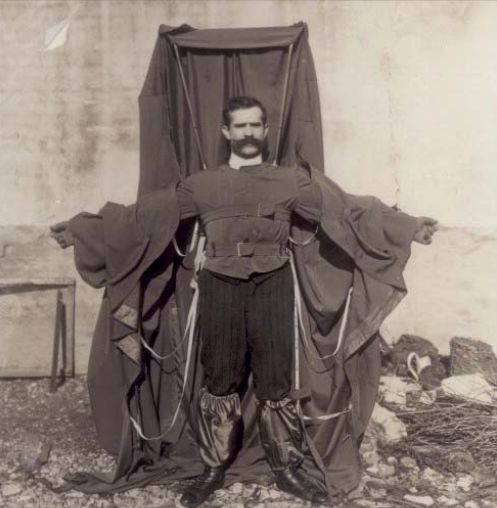
Reichelt The Flying TailorFranz Reichelt, sometimes known as The Flying Tailor, was a man who didn’t know when to say quit.

Quotes are from the wikipedia.

Reichelt had become fixated on developing a suit for aviators that would convert into a parachute and allow them to survive a fall should they be forced to leave their aircraft.

Living in France, in the early 1900s, it was impossible to avoid the explosion of enthusiasm flight was undergoing, and Reichelt felt he had an important contribution to make.

He presented his design to the leading aeronautic organization, La Ligue Aérienne at the Aéro-Club de France, hoping that they would test it, but they rejected his designs on the grounds that the construction of the canopy was too weak, and they attempted to dissuade him from wasting his time on further development.

Which is a nice way of saying they told him to knock it off – of course, he wouldn’t listen. What was driving the man? Fame? The Romance of the Skies?

Money?

In 1911, Colonel Lalance wrote to the Aéro-Club de France, offering a prize of 10,000 francs for a safety parachute for aviators – double the prize he had offered the year before.

Whatever the case, he got back to work:

Eager to participate, Reichelt refined his design, reducing the weight while increasing the surface area […] Further tests proved no more successful than his earlier attempts: his dummies invariably fell heavily to earth.

– and there’s the problem: despite some initial success, Reichelt had never had a successful test. He even decided to take his failures on the road.

L’Ouest-Éclair reported that in 1911 he had then made a jump himself from a height of 8 to 10 metres (26 to 33 ft) at Joinville. The attempt failed but his fall was cushioned by a pile of straw, which helped him escape injury. Le Matin reported an attempt at Nogent from a height of 8 metres (26 ft) that resulted in a broken leg.

The tailor was convinced he had the problem licked – all he needed was more height.

Reichelt announced to the press in early February 1912 that he had finally received permission and would shortly conduct an experiment from the Eiffel Tower to prove the value of his invention.

The apparent assumption behind his test was that he was going to be using a dummy.

M. Hervieu, who was present to witness the demonstration, also attempted to dissuade him from making the jump. He was concerned that the parachute needed longer to fully open than the few seconds the drop from the first platform would allow, and he also presented other technical objections to which Reichelt could not provide a satisfactory response.

The end of the experiment wasn’t pleasant. If nothing else, Reichelt stands in history as a reminder to believe your own lying eyes, and, that if something in your thinking isn’t working, it may be you.

His parachute, which had seemed to be only half-open, folded around him almost immediately and he plummeted for a few seconds before crashing into the frozen soil at the foot of the tower. […] Le Figaro noted that his eyes were wide open, dilated with terror.

To my thinking, one of the saddest aspects of his tale – if you’ll note the picture at the start of this post – was that, despite his failings as an aeronaut, he seemed to be quite a talented tailor.

[youtube=http://www.youtube.com/watch?v=BepyTSzueno]

FlashCast 003 – Nycast

FlashCast 003
[audio:http://traffic.libsyn.com/skinner/FlashCast003.mp3]
(Download/iTunes)

Prepare yourself for favouritism, nyquil, Texans, love, and more accents.

Stories mentioned in this episode:

– and big thanks & accolades to Barry of Mr Blog’s Tepid Ride, Nick Tyler of Captain Pigheart, and Friend Of The Site, Ray.

* * *

If you have comments, questions or suggestions, you can find us at http://skinner.fm, call our voicemail line at (206) 338-2792, or email us text or mp3s to skinner@skinner.fm.

FlashCast is released under the Canadian Creative Commons Attribution-Noncommercial 2.5 License.

A Tank-less Job

Reader Jeff Pyrotek left me a comment on Facebook, admonishing me for my lack of info on Russian anti-tank dogs in the last post.

Frankly, it was because I’d never heard of them.

All quotes are from the wikipedia

They were intensively trained by the Soviet and Russian military forces between 1930 and 1996 and used in 1941–1942 against German tanks in World War II. Although the original dog training routine was to leave the bomb and retreat so that the bomb would be detonated by the timer, this routine failed and was replaced by an impact detonation procedure which killed the dog in the process.

How do you train a dog to destroy a tank?

First, you deny it dinner.

Dogs were trained by being kept hungry and their food was placed under tanks.

Unfortunately, a lack of nutrition was the least of the canines’ problems. Unlike the relatively lucky American mutts, these pooches were expendable.

Their deployment revealed some serious problems. In order to save fuel and ammunition, dogs had been trained on tanks which stood still and did not fire their guns. In the field, the dogs refused to dive under moving tanks. Some persistent dogs ran near the tanks, waiting for them to stop but were shot in the process. Gunfire from the tanks scared away many of the dogs.

[…]

Another serious training mistake was later revealed; the Soviets used their own diesel-engine tanks to train the dogs rather than German tanks which had gasoline engines. As the dogs relied on their acute sense of smell, the dogs sought out familiar Soviet tanks instead of strange-smelling German tanks.

Dogged

Dogs In A RowSpeaking of what you might do for your government, I meant to post up this little nugget regarding war dogs yesterday, but got side-tracked.

From the wikipedia:

1943–1945: The United States Marine Corps used dogs, donated by their American owners, in the Pacific theater to help take islands back from Japanese occupying forces. During this period the Doberman Pinscher became the official dog of the U.S.M.C.; however, all breeds of dogs were eligible to train to be “war dogs of the Pacific”.

These dogs were accepted into service after being ‘volunteered’ by their human caretakers, or, if the movie Courage Of Lassie is to be believed, after being found stray.

A “basic training” period was initiated where dogs were trained to carry out certain fundamental commands such as sit, stay, come, etc… They were also accustomed to muzzles, gas masks, riding in military vehicles and to gunfire. – qmfound.com

After basic training, the dogs would specialize in a specific task, usually scout or guard duty, although occasionally in being messengers or mine-detectors.

The scout dog and his Quartermaster handler normally walked point on combat patrols, well in front of the infantry patrol. Scout dogs could often detect the presence of the enemy at distances up to 1,000 yards, long before men became aware of them. When a scout dog alerted to the enemy it would stiffen its body, raise its hackles, pricking his ears and holding its tail rigid. The presence of the dogs with patrols greatly lessened the danger of ambush and tended to boost the morale of the soldiers. – qmfound.com

Lessen the dangers of ambush, possibly, but not entirely negate them. I couldn’t find a casualty count for canine combatants during WWII, but I imagine being specifically used as the method of determining first contact would lead to quite a number of close encounters.LIFE War Dog

At the end of the war the Quartermaster Corps put into operation a plan for return of war dogs to their civilian owners. Dogs were sent to a reprocessing section for the purpose of rehabilitation for civilian life. Dogs were trained that every human was friendly and tested for such things as reaction to people riding around them on bicycles or placed in an area with a great amount of noise. Before return, each dog was given a final check by a veterinary officer. Shipment of the dog to the owner was made at government expense. Those dogs which the original owner did not desire were sold to the public by the Treasury Department with the assistance of Dogs for Defense. By early 1947 the return of all borrowed dogs was completed. – qmfound.com

Which almost seems like a more careful and tender-handed release process than most modern human soliders get these days.

The wikipedia:

Of the 549 dogs that returned from the war, only 4 could not be detrained and returned to civilian life.

Were these four dogs put down – or were they the start of a secret, elite K9 combat unit?
Pfc. Rez P. Hester, 7th War Dog Platoon, 25th Regt., takes a nap while Butch, his war dog, stands guard.  Iwo Jima, February 1945.  S.Sgt. M. Kauffman.