Category: Uncategorised

171 – The Conjurer: a Blackhall Tale, Part 1 of 1

Welcome to Flash Pulp, episode one hundred and seventy-one.

Flash Pulp

Tonight we present, The Conjurer: a Blackhall Tale, Part 1 of 1.

[audio:http://traffic.libsyn.com/skinner/FlashPulp171.mp3]Download MP3
(RSS / iTunes)


This week’s episodes are brought to you by The Bothersome Things Podcast.


Flash Pulp is an experiment in broadcasting fresh pulp stories in the modern age – three to ten minutes of fiction brought to you Monday, Wednesday and Friday evenings.

Tonight, Thomas Blackhall, master frontiersman and student of the occult, encounters a practitioner of dark artifice while awaiting transportation.


Flash Pulp 171 – The Conjurer: a Blackhall Tale, Part 1 of 1

Written by J.R.D. Skinner
Art and Narration by Opopanax
and Audio produced by Jessica May
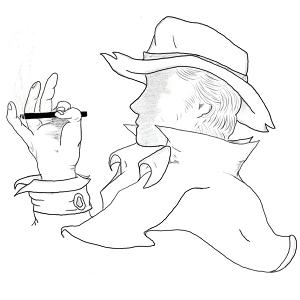
 

BlackhallAt the edge of an Eastern District dock sat three men awaiting the craft they’d been assured would arrive to take them further westward, out of the civilized portions of Upper Canada, and past the expanses labeled only as “Great Tract of Wood Land” on even the most recent of the new Queen’s maps.

The traveller who’d introduced himself as Mister Philips, a rough-faced farmer who tended a plot of land deep in the shadows of the black spruce, was winding down a protracted telling, and wiping a rag across the damp slick at the base of his neck.

“Despite that I’d suckled it from the day my musket knocked down its mother, the beast ate up my swine. Energetic from its meal, and free of its leash, it mightily walloped the interior of my barn, then, collapsing the lumber, it made its way into the bush country.

“You can see, sir, that raising a bear is no light business.”

His companion in conversation, a heavyset gadabout, whose groomed sideburns stretched to meet his masterfully crafted moustache above a strong, but barren, chin, harrumphed before responding.

“While your point is certainly well taken, I’ve a long history of probing the improbable and producing anything which was thought impossible. That is not, certainly, to imply I have any intention of cultivating a cub of my own, but I do dare say that the act would be well within the capabilities of Abraham Warwick, conjurer, exorcisor, and archimage.”

He bowed slightly at the completion of his delivery, but not so far as to upset the position of his towering beaver-pelt top hat.

“A man of supernatural knowledge?” replied the homesteader, “Surely, you banter idly.”

“Then what of this?” riposted the claimant, tapping his head-wear with a flourish, then sweeping his arm to display its empty state to his pair of audience members. Replacing it upon his pate, he drummed at its surface a second time, and once again removed it, bowing low.

From the interior brim peered three white mice, whose red eyes dodged about keenly and whose pink noses worked vigorously at the breeze.

Atop the stout barrel he’d been utilizing as a resting place during their shared vigil, Thomas Blackhall found he was no longer willing to maintain his silence.

“It’s been my experience,” he said, “that those who practice magic are oft like politicians – it’s a rare thing to meet an honest one, and most accomplish their goals not through the truth they attempt to present, but instead with nimble fingers and deft lies.”

“Well,” replied Philips, “I thought it was quite extraordinary.”

Thomas waved off a persistent black fly.

“He’s obviously trained the vermin to nest in his hair.” Blackhall paused to bite at his thumbnail, and temper his language. “Think how long the hush lasted, in this swampy heat, before you finally told us of your departed bruin. Consider, too, where those beasts must be, uh, marking their business.”

“Tis no concern if the beauties are conjured from a realm beyond,” huffed Warwick.

The farmer nodded agreement.

“Seems a shoddy mystical dimension to be infected so greatly with rodents,” replied the still seated frontiersman.

The self-proclaimed warlock leaned forward, saying, “- and what of this then?”

With a snap he seemed to pluck a twelve-pence piece from just behind the ear of the ploughman.

“Well, goodness!” exclaimed Philips.

Warwick pocketed the coin.

“Surely -” began Thomas, but the cropper rounded on him.

“You speak quite rudely to a man who’s shown us not one, but two, great works, and only since our approach to this shoddy jetty. Might I trouble you for what credentials you claim in impugning this sage’s proofs? For if you are more than some deserting rabble from the continental army, it is not apparent from your stained appearance or grizzled words.”

The heat had shown no mercy to Blackhall’s public countenance, and he knew it. Still, the reality was that he’d had plenty of opportunity to witness Warwick’s slight of hand, upon the porch of The King’s Inn, and he’d already run short of patience for the showman, who he considered little better than a vagrant sharper.

Swatting at Philips’ ear, as if to shoo a fly, the magician produced another shilling.

“It only seems fair that we split the profits of our encounter, good sir,” he said, placing it in his supporter’s palm.

Thomas stood.

“I will show you something truly fantastic, but first we must make a trade. You are flush with coinage, mayhaps from a local card table? Whatever the case, I ask you to entrust it to me. I promise I will not move beyond your sight.”

After a moment’s hesitation, Philips complied.

Blackhall quickly stripped off his coat and sword, laying all in a great heap aside his travel sack.

“I request, also, that you keep this scoundrel well from my supplies while I am below the surface.”

He knew the simple mention ought to be enough to guard against the potential thief, who would fear suspicion upon himself.

Without waiting for reply, Thomas grasped the sack of currency tightly in his off-hand, and jumped into the cool waters,whose depth covered his own height by some two feet. As he descended, he placed the stone, which he wore upon a rawhide strand about his neck, under his tongue.

The occult charm left him breathing easily, and he was relieved to be away from the conversation and swelter.

He gave an approving hand sign to his spectators, who motioned a reply, and he made ready to wait as he was gently rocked by the languid current.

Finally, when his eyes made contact with the churn of the approaching barge, he surfaced.

“I agree that you too have talents for which I have no explanation,” said the farmer, tucking away his returned bounty as the swimmer dried himself and the boat drew near, “but, in truth, you’ve both shown me things which, until today, I would have thought not possible. Who am I to say that a never-ending stay within the river is somehow better than an unending supply of wealth?”

As the man spoke, Blackhall retrieved a small vial from within his wares.

“Fine,” he said.

Warwick took on a look, as if he were preparing to present yet another trick, but, before he could act, Thomas threw down the glass tube, shattering it upon the wooden planking. As a small pop emanated from within, the hurler uttered three guttural consonants.

The hat of the conjurer, exorcisor, and archimage, was suddenly aflame.

There was a brief panic as the width of the landing was crossed twice, then the blazing apparel was cast into the stream – amongst its former wearer’s singed strands, the mice chittered, scurrying furiously about their limited plateau.

Thomas finished dressing.

As the transport secured its riggings, its passengers waited a time in silence; one puzzling, one frowning, and one suppressing a rare smirk.

“Excuse my curiosity, by why did you require my funds?” asked Philips, as they boarded.

“Partly as collateral to secure my own belongings against theft, but also to keep your limited fortune from subtle pinches. It’s not an inexhaustible income if its source is the pocket of the same baffled admirer from behind whose ear the tender seems to be produced. Worry not, however – you’ll have plenty of opportunity to count your claim and even the tab as we go. I doubt Warwick has much choice about awaiting a later berth, as its likely the townsfolk will soon be considering the state of their own purses.”

The red-cheeked hustler made no interjection.

It would be a slow crawl up the river, but Blackhall found himself quite amused throughout.


Flash Pulp is presented by http://skinner.fm, and is released under the Canadian Creative Commons Attribution-Noncommercial 2.5 License.

Text and audio commentaries can be sent to skinner@skinner.fm, or the voicemail line at (206) 338-2792 – but be aware that it may appear in the FlashCast.

– and thanks to you, for reading. If you enjoyed the story, tell your friends.

Lost & Found

http://en.wikipedia.org/wiki/Antikythera_mechanismThe Eights are out with the same flu I just recovered from, so I’ve barricaded myself in my office, very much in the style of the climax of The Blues Brothers. I’ve got enough coffee to hold me for hours, but I should have better planned for my bladder.

What I really wanted to discuss, however, was the Antikythera mechanism.

It was discovered in a shipwreck off Point Glyphadia on the Greek island of Antikythera. The wreck had been discovered in October 1900 and divers had retrieved numerous artifacts, most of them works of art, which had been transferred to the National Museum of Archaeology for storage. On 17 May 1902, archaeologist Valerios Stais was examining the finds and noticed that one of the pieces of rock had a gear wheel embedded in it. Stais initially believed it was an astronomical clock, but most scholars considered the device an anachronism, too complex to have been constructed during the same period as the other pieces that had been discovered. However, investigations into the object were soon dropped until English physicist Derek J. de Solla Price took an interest in it in 1951.

The circumstances under which it came to be on the cargo ship are unknown. Investigators have suggested that the ship could have been carrying it to Rome, together with other treasure looted from the island to support a triumphal parade being staged by Julius Caesar.

wikipedia

What an odd and fabulous device. There are a number of far-fetched theories surrounding its purpose and origin, but I would argue the mundane reality is the best option: a scientific calculator so complex that modern science refused to believe it was even possible for its period to have built it, possibly lost at sea while on its way to take part in the pageantry of Caesar – what more could you want?

The real lesson here, I think, is how delicate our knowledge and handiwork can be, and how easily they are lost to history. I’ve heard it bandied about that the Antikythera mechanism’s technology and precision wasn’t remastered for a thousand years – at least it’s only been two or three hundred years since we lost the recently (sort of) recovered technology of wind-powered sailing.

Mr Wrage’s sail is actually an elaborate kite to help capture the power of the wind, using the energy to supplement convention forms of power. In trials this year on the waters of the Baltic Sea, he has performed the nautical equivalent of reinventing the wheel. By switching to wind power during favourable conditions, energy costs could be slashed, perhaps by more than half.

The Independent

One of Mr Wrage's sails

What's What

Row-botsDue to the illness that laid me low earlier in the week, some changes to the schedule are necessary.

Rather than turn out inferior product in an attempt to catch up, I’m going to reset the schedule a bit – tonight’s story will go up tomorrow, (once the script has had a thorough wash & wax,) and FlashCast 22 will release on Sunday.

Next week we’ll be presenting a full trio of stories; it’s my hope that, by not killing myself in an attempt to make up for what is already lost, we’ll be able to release the week’s episodes around noon of their promised day.

Honestly, recent donations – many thanks Joe of the PRB and Jeff – have really lit a fire under my muse, but, while the spirit is willing, the mind is still a quivering heap of post-fever goo.

In the mean time, have you had an opportunity to listen to last night’s episode? Last week’s FlashCast?

Whatever the case, we appreciate your patience.

170 – Time Bomb, Part 1 of 1

Welcome to Flash Pulp, episode one hundred and seventy.

Flash Pulp

Tonight we present, Time Bomb, Part 1 of 1.

[audio:http://traffic.libsyn.com/skinner/FlashPulp170.mp3]Download MP3
(RSS / iTunes)


This week’s episodes are brought to you by The Bothersome Things Podcast.


Flash Pulp is an experiment in broadcasting fresh pulp stories in the modern age – three to ten minutes of fiction brought to you Monday, Wednesday and Friday evenings.

Tonight, we present a strange interlude; a visitation to a secluded island, floating atop a sea of farmland.


Flash Pulp 170 – Time Bomb, Part 1 of 1

Written by J.R.D. Skinner
Art and Narration by Opopanax
and Audio produced by Jessica May


Chiller WolfAbdi passed a man touching up a sign proclaiming “As for me and my house, we will serve the lord!”, and cursed gently into his phone.

“I can’t get any proper ####ing reception, Allie. I’ll be home in an hour, tell him I said to put them back in the toy box, and if he still won’t, give him a time out and leave him there until he will.”

The painter threw a look over his shoulder and nodded a greeting. As he returned to his work, Abdi picked up his pace.

“Yeah, sorry, I know you don’t need me to-“

Allie’s response carried past a sun baked cow pasture. A lone black-and-white cud chewer took in the conversation intently.

“Hah. Yeah. I understand – it’s okay. Listen, I’ll cut this thing short, instead of hoofing it, I’ll give you a call and the two of you can come for an adventure and get me. I needed a little time to air the smell of gooed fruit loops from my brain, and I’d really like to look into this – I’m so close now, an hour more, tops.”

He smiled.

“Yep, promise – as soon as I’m done. Love you too. Bye.”

He pocketed his cell as the bovine gave him a skewed final gaze and turned towards a patch of taller weeds.

Retrieving a folded sheet of crumpled printer-paper from his pocket, he eyed his recently rejoined route. Country blocks didn’t allow a traveler many directional choices, but, despite his deceptively simple path, Abdi had spent the better part of the morning lost. He wasn’t eager to be thrown off course a second time by again missing a grown over trail that was somehow included in Google’s mapped directions.

Another half-hour brought him to a prodigious expanse of lawn – recently cut – and a two story house, made tiny to his eye by its distance on the far side of the grassy buffer. Behind it stood a massive barn edging on a sea of tall grain, and terminated on the horizon by dense forest. Abdi stopped at the head of the driveway to confirm the address against the crisply hand painted numbers on the pale gray mailbox, and considered the leagues of tar-paved drive.

Unable to locate a call-box, he ducked between the wide bars of the closed cattle gate that blocked the way, and resumed his pace.

Although he’d been walking since early morning, the approach to the residence seemed the longest of the distances he covered.

Initially, knocking at the side-entrance brought no response. Lacking a doorbell to try, he hammered harder.

Over his head, from an open window on the upper level, a man, sounding ancient, told him it was open.

Abdi could see no one beyond the white-lace curtain that waved with the breeze.

Shrugging, he pulled at the green-framed screen.

The first floor of the house was dense with knickknacks on shelving units erected in front of any sizable length of wall. The decorator was apparently a compulsive collector of spoons, dolls, and plates with prints of birds in vivid reds, blues and yellows.

He was reminded of a Somali proverb his parents had carried with them when they’d come to America, and had usually applied when discussing an Aunt they especially felt needed to be married: “a childless old lady is obsessed with seashells.”

Abdi assumed the pack rat was the woman he’d talked with earlier, Rosemary. Her excessive politeness, and un-joking use of the word “gosh”, had left him in mind of a bashful spinster, and the ornamentation only seemed to prove it. He hated to be a bother to someone so well mannered, but, still, as his choice to walk instead of drive had made him late, he was glad he’d haggled down the price while on the phone.

It was the male voice, though, that he continued to hear. He couldn’t make out what it was saying, but the occasional muffled exclamation was enough to bring him to a staircase.

As he rose above the tide of clutter, he noted that the ascent was decorated with a simple series of framed photographs. All of the same man, at first young, and in full dress uniform while sitting on the wing of a large plane. Then, with mud up to his neck and what appeared to be an ocean behind him and a trio of comrades beside – and another, a solo shot, on a sandy beach, shirtless and holding a vicious looking rifle. The final picture, at the landing, was a studio portrait, his uniform now crisp. Early age was creeping around his right eye, and the left side of his face covered in a web of partially-healed creases. Written in pen, in the bottom right-hand corner, was a name: “Merle”.

The second story’s surfaces were universally white, and the shaggy carpet, a worn brown.

Although he was presented with four options as to closed rooms, the hidden muttering assisted in making his selection.

Eager to get home, Abdi cleared his throat and gave a gentle double-rap to announce his presence.

Sitting before him, in a formerly-white shirt and black jogging pants which strained at their seams, was a much older, much wider, version of the combatant in the photos.

Merle grunted and a made a sound that started mushy and ended with an open vowel. It might have been Hi, Huh, or How, his visitor couldn’t tell. The chair that held the former-soldier’s girth gave a pained creak, and, with another snort, the old man was moving.

Unable to maneuver in the tight hall, Abdi led the way, walking with his body half turned to attempt and predict their destination. Stopping at a plain door, no different than the other three, Merle wrapped his palm around the handle, and twisted.

The room was surrounded with shelves, but, unlike the clutter of the first floor, each appliance seemed to be carefully placed, as if there was some strategy to their storage even if it wasn’t immediately obvious. The range of memorabilia was impressive, mixing devices with bright red Bakelite panels, radios with their cloth cross hatched covers well preserved, and even toys with shining chromed-exteriors. Abdi thought it unlikely anything in the space had been constructed before 1955.

Rosemary, who he now guessed to be Merle’s daughter, had said her father collected together the vintage items years ago, but she’d also left him with the impression that the old timer was incapacitated, and that her sales were an effort to pay for his medical care.

Whatever the case, his misgivings were washed away in his wonder at the array of classic knobs and gleaming dials.

It wasn’t until he was on the floor, with his right ear aching, that he realized something was dramatically wrong.

An ancient loafer, the leather cracking and peeling along the seams, lifted, then came down with jackhammer-purpose.

As the foot landed just wide of its target, Abdi crab walked towards the exit.

“FWAR GHLUS KWEPH.” Merle gurgled in rage.

Throwing open a cabinet, the old man suddenly had a shotgun in one hand, and shells in the other – it was only his pudgy fingers that bought his intended victim time.

Now panicking, Abdi had little interest in discerning the motivation behind the assault – instead he found his feet in the hall, and sprinted for the stairs. His peripheral view was temporarily eclipsed by the veteran’s mass, and the beach picture jumped from the wall with a clap, but his momentum carried him through his fear, and he ignored his sneakers – which he’d taken off upon entering the home – as he blurred past the tchotchkes and onto the drive.

At the mid-point, he realized he was still being chased. His eyes remained locked on the gray bars of the gate that marked the road, but the unintelligible string of gibberish, which came from behind him, gave some indication as to how distantly Merle was lagging. Although the gap only widened, the thought of the weapon in the deranged man’s hands made any span seem all too short.

Abdi thought of the baby. He thought of Allie. He thought of the wasted time he’d spent that morning – maybe his last – which he could have spent with his wife and child. As his cotton socks ripped, and his feet stung on the hot laneway, he wept – he wept, and he ran.

He was beginning to think he might just survive the ordeal when a pickup stopped on the far side of his destination.

A woman stepped out, and the tormented runner considered leaping for the ditch which flanked the field of green – before he could, however, the newcomer shouted to him.

“I am so sorry!”

The kindness was enough to bring him up short and consider his situation.

It was true that his pursuer was still coming, but the rotund man had barely covered a quarter of the expanse, and his bouncing gait was making it difficult to reload the opened shotgun, despite his constant effort.

Moving slower now, and attempting to catch his breath, Abdi climbed over the fence and circled the truck for shelter.

Her face filled with apologies, Rosemary joined him.

“Dad is like one of those World War II Japanese soldiers who kept on fighting, out on their own little islands, way after the war had ended. For him it’s always an August dawn in Somalia, back in 1993. It’s not his fault though, it’s the metal chunks in his brain. He thinks he’s still overseas and fighting. I never thought, though, that you -”

Behind the plastic frames of her glasses her eyes had been tracking her father’s progress, until, with a final huff, he’d collapsed onto the drive.

She bolted to his side, her sensible brown dress waving against the wind of her pumping legs.

“Fowup mugug,” he said, his mouth turned towards the tar-paved ground.

They were his final words – for Merle, the war had ended.


Flash Pulp is presented by http://skinner.fm, and is released under the Canadian Creative Commons Attribution-Noncommercial 2.5 License.

Text and audio commentaries can be sent to skinner@skinner.fm, or the voicemail line at (206) 338-2792 – but be aware that it may appear in the FlashCast.

– and thanks to you, for reading. If you enjoyed the story, tell your friends.

Parenting Pro-Tip

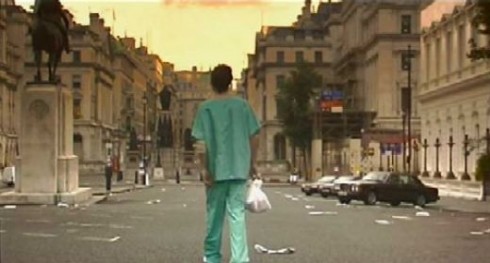
Still from 28 Days Later
Having multiple school-aged children is like licking a mangy goat that’s just finished wildly rampaging through the scariest of the Center for Disease Control’s storage freezers.

Either burn everything they’ve worn in their school day and put them through a series of intense radiation baths, or consider living in a hazmat suit for sixteen years.

I may install a kiddie pool full of antibacterial hand-sanitizer in the front yard.
Kiddie Pool

A Brief Audio History

Olden DaysA conversation with Mac, in the comments section of a recent post, caused me to dig through the archives a bit and look into the history of ambient audioboos I’ve released over the last twelve months or so.

Honestly, the little audio-scrapbook it’s become has me wishing I’d been doing them for years – why do we so carefully record the visual aspects of things we find exotic or worth remembering, but forget to record our audio impressions, which can be just as distinctive?

Care to follow me into a bit of time travel? Find them, in reverse chronological order, here.

New Urban Legend: The Pool Boy

A new myth for you:

Mundin's PoolIn the small town of Mundin – although the story has spread to most of its neighbours, and beyond – is a public swimming pool housed in a squat red-brick building.
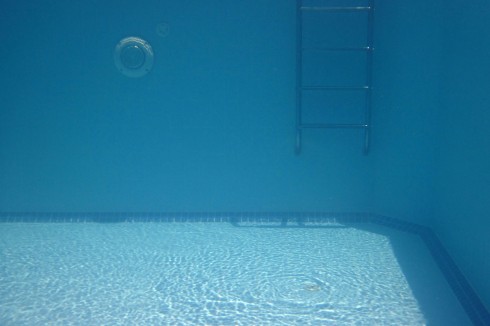
On a warm summer’s day in 1987, Mitchell Dugas, known-drunk and the custodian in charge of maintaining the facility, over-compensated for a recent lack of maintenance by saturating the water’s chlorine level well beyond safe levels. Although the problem was not immediately obvious to those swimming, accounts of the incident say that Matty Smith, a boy of seven, was pushed into the deep end by an unidentified ruffian, and, in his panic, drank several mouthfuls of the tainted liquid.

Although he was quickly pulled from the water by the lifeguard on duty, blood was soon seen to be running from his nose, and, before any further first aid could be applied, he expired on the damp tiles at the pool’s edge.

Less verifiable is what happened some months later. With the coming of fall, and the lingering stigma of the death, the facility was seeing considerably less use. One September evening a side access door was left accidentally unlocked, and a trio of teenagers gained entry.

Intending only to dip her feet, one of the youths discovered that, despite the intensity of the smell of chlorine, the pool seemed to have been covered over with glass. Standing, she realized it could easily manage her weight. Soon all three were atop the invisible layer, running and cartwheeling. It was only when they’d gathered at the deepest portion, however, that the support gave way to a sudden bath.

It would have been little issue, as all three were capable swimmers, but the barricade had apparently returned, entrapping them beneath.

It was only the lucky approach of Dugas’ replacement, who’d realized he’d likely missed securing one of the entrances, that saved them. It’s said he swears the pool’s surface was undisturbed although he could clearly see the teens thrashing beneath, but, as his hand touched the cold damp, the barrier seemed to disappear.

Many who’ve visited the deep-end since have claimed the feeling of child-like fingers upon their ankles, but no further deaths have been identified as anything more than accidental.

source

Swimming Pool