Welcome To Tuesday
Hello and welcome to the next step in your week.
I was digging through my phone’s memory, and recalled that I’d intended on posting this up;
Snails – nature’s RVs:

Hello and welcome to the next step in your week.
I was digging through my phone’s memory, and recalled that I’d intended on posting this up;
Snails – nature’s RVs:
Welcome to Flash Pulp, episode one hundred and sixty-four.

Tonight we present, Coffin: Siren, Part 1 of 1.
[audio:http://traffic.libsyn.com/skinner/FlashPulp164.mp3]Download MP3
(RSS / iTunes)
This week’s episodes are brought to you by the Flash Pulp Facebook page.
It’s like a basement full of friends you didn’t know you had.
To join, click here.
Flash Pulp is an experiment in broadcasting fresh pulp stories in the modern age – three to ten minutes of fiction brought to you Monday, Wednesday and Friday evenings.
Tonight, Will Coffin, urban shaman, and his thirsty companion, Bunny Davis, find themselves locked in hand-to-hand combat with a civil servant.
Flash Pulp 164 – Coffin: Siren, Part 1 of 1
Written by J.R.D. Skinner
Art and Narration by Opopanax
and Audio produced by Jessica May
 The two-story suburban home’s upper windows had shattered under the heat of the blaze, but those on the lower floor remained closed, except a single pane in the front living-room, which had been cracked against the vigour of the air conditioner, and now allowed an outlet for the black smoke column that blew outwards as if tainted-steam from a roiling kettle.
At the center of the throng which had assembled to spectate the combustion, a steel-haired man held a weeping woman whose eyes peered constantly over his comforting shoulder, watching a lifetime of memories and knickknacks turned to kindling.
On the crowd’s furthest edge, however, Bunny Davis was engaged in a fist fight. Her whisky habit had her at a disadvantage as far as accuracy or balance were concerned, but, liquid bravery, and a fast moving mouth, had kept her upright thus far.
She took another swing at the firefighter, but, again, her punch slid along the clear Plexiglas-visor with little effect.
“Fargh,” said Will, only four-feet away, but entirely occupied with the stinging fury brought on by the can of mace he’d intercepted with his eyes.
“You ####ing pole-sliding truck-rider, just turn a-####in’-round and head back to your Ghostbusters shack.”
The woman behind the breathing mask responded with a strong right to the nose, which put Bunny over backwards, and brought the smell of copper to her nostrils.
Her impediments disposed of, the fire-woman strode towards the burning structure, laid a boot to the front door, then entered.
The onlookers cheered.
Bunny, finding her feet, rubbed at her aching gin-blossoms as she watched a man, unseen by the majority of the gathered, move to the left-most window on the second floor.
With the flames framing his silhouette, he rubbed at his sharp-cornered chin, then stretched his muscled shoulders with a languid roll.
As his white t-shirt ignited, he began to strum his guitar.
* * *
A week earlier, Coffin and his tipsy roommate had been loitering in front of the Eats’N’Treats, busied largely with ignoring the glaring sun and the uncomfortable bench.
Bunny had located an abandoned newspaper, and was filling the time remarking on random entries as she used the broadsheet as cover to move vodka from her pocket to her mouth, and back again.
“Holy ####,” she said, sipping, “looks like they’re playin’ the original Planet of the Apes downtown, I love that movie. Charlton Heston is the loudest ####ing actor I’ve ever seen. Sum##### lands on a planet full of monkeys and what’s he do? Yells at ‘em till they give him part of the Statue of Liberty – or, whatever, I mean, it’s been a while – but what then? Yells at ‘em some more.”
“That’s not quite how the film goes,” replied Will.
“Whatever, all I’m sayin’ is the man was a god #### genius.”
Coffin’s attention, only marginally involved in the conversation, was on a white truck sitting idle between a pair of the lot’s faded yellow lines. The vehicle had parked five minutes earlier, but a passenger had yet to emerge.
“No one shouts like Heston anymore,” Bunny continued. ”I blame Clint Eastwood.”
The pickup’s door swung open, and a squat woman stepped down from the running-board. It was tough to tell her age, as she wore large black sunglasses which reminded Will of the visors occasionally worn by the blind, and the thick plastic left nothing but her furrowed cheeks as a clue. He guessed sixty.
“I’m looking for a Mr. Will Coffin,” she said.
“I’ve heard of him,” replied Bunny. “Lazy #######, that one.”
“Sorry,” said Will, “pay no mind to my, uh, assistant; too much sun, and too much cheap raspberry vodka, and she gets a little talkative. Something I can be of help with?”
“Name’s Euphemia Dumfries. I’m a fire chaser out of the station at main and baseline. A paramedic friend of mine said I should talk to you – I, uh, a month ago we were responding to a basement fire and I heard this song. Simple thing, just an acoustic guitar and a strong voice – but it came floating over the heat, like a melody made of smoke. I’m hearing this tune over the crackle and pop, and I see this guy on the second floor. I lost it a bit, and pushed further inside than I should have. I caught myself just before running into the living room, where the floor was gone entirely. Scary thing about basement fires, you get down below ground-level with no stairs and you’re basically standing in a barbecue pit. Anyhow, I was fine, but I was sure the fella was a goner – thing is, even once things were cleared, we didn’t find anyone.”
She paused in her story, and Will stood, offering her his spot on the bench.
Shaking her head, she pushed out a breath and then continued.
“I’m old for the work – if I didn’t come so cheap and have the strength of an Alabama chain gang, I’d’ve been off the truck a long time ago. I didn’t want to put in for a talk with a doc, as I figured they’d use it as the last straw. A couple weeks later though, we were dousing a garage over on Melville, and it hit a propane tank the home owner had forgotten under a pile of newspapers he’d intended on recycling. Brilliant. Blew out the drywall and his kitchen went up like a match. Now, I’m way back at the truck at this point – and I hear it again. There was the same guy, thirty-ish, and pretty like a TV doctor. He was at the second floor window again, and he was singing – he was singing to me. I don’t really know what happened. I kicked through the front door, which was relatively unscathed, and bolted upstairs. I stomped into a guest bedroom, and there he was. He smiled, then he said ‘44 Wiltshire.’ That’s on the east end of town. What I didn’t know was that things were pretty much under control on the ground floor. As soon as the danger was gone – so was he. I got my ### chewed out something fierce for acting like such an idiot with nothing to show for it.”
“Not your fault, really,” said Coffin, “I’ve heard of your troubadour. Died a decade and a half ago while writing a song for his wife in their bedroom. Story goes that the place burned down while she was off wrestling with his best friend. Now he serenades bystanders, and apparently first responders, from the interior of burning homes, hoping they’ll join him inside.”
“Why does he do it?” asked Euphemia, “and is there a way to stop it?”
“Well, spite, partially, but I figure he’s probably hoping one will go willingly. He’s claimed a few lives, but I doubt they were inclined to hang around with him in the afterlife, so his desire – for companionship – goes unsatisfied.”
“Was a good looking eternity, to me.” she replied. She adjusted her glasses and cleared her throat. “Honestly, I guess I knew the answer all along. I live to help, and, truth is, I’m getting old. If I don’t die in my boots shortly, I’ll end up accidentally doing so alone in my own bed.”
They’d argued the point for seven days.
Flash Pulp is presented by http://skinner.fm, and is released under the Canadian Creative Commons Attribution-Noncommercial 2.5 License.
Text and audio commentaries can be sent to skinner@skinner.fm, or the voicemail line at (206) 338-2792 – but be aware that it may appear in the FlashCast.
– and thanks to you, for reading. If you enjoyed the story, tell your friends.
Coffin’s theme is Quinn’s Song: A New Man, by Kevin MacLeod of incompetech.com
 |
 |
 |
 |
(Mouse-over for episode titles, click to read/listen. Blog content begins below.)
Don’t forget to subscribe via iTunes to get the episodes hot off the mic!
 Despite its generally positive portrayal of diversity, even in the the marvelous Land of Oz, lack of equality was apparently a problem.
In the 1939 movie The Wizard of Oz, Toto was played by a female brindle Cairn Terrier whose real name was Terry. She was paid a $125 salary each week, which was far more than many of the human actors (the Singer Midgets who played the Munchkins only received $50 a week. From Oz Wiki: The performers were paid $50 per week plus expenses during the preliminary costume and makeup tests, and $100 per week through the rehearsal and filming of the Munchkin scenes.
Of course, this comes from a period when it was considered fair game to play up a dog at the expense of some human stereotyping.
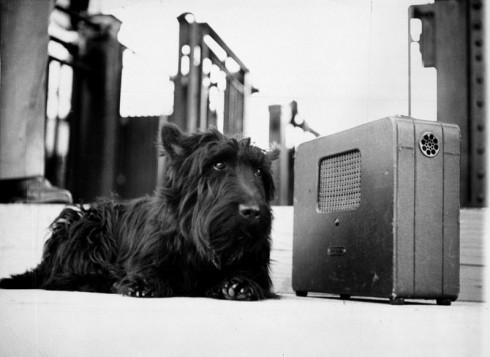
For example, here’s a bit of FDR defending himself against the birther-conspiracy of his day – that he’d lost track of the presidential pup during a naval tour, and had retrieved him only at massive expense to the taxpayers (emphasis mine):
You know, Fala is Scotch, and being a Scottie, as soon as he learned that the Republican fiction writers in Congress and out had concocted a story that I had left him behind on the Aleutian Islands and had sent a destroyer back to find him–at a cost to the taxpayers of two or three, or eight or twenty million dollars–his Scotch soul was furious. He has not been the same dog since.
Which, to my mind, seems to imply that FDR’s dog was so Scottish, and thus supposedly cheap, that, realizing he’d been left behind, the pooch refused the costly ride, instead constructing a raft of cabers and modifying a bagpipe to act as propulsion.
This may seem far-fetched, but have you ever met an Irish Setter? Drunks, the lot of them.
 [audio:http://traffic.libsyn.com/skinner/FlashCast019.mp3](Download/iTunes)
Hello, and welcome to FlashCast episode nineteen – prepare yourself for Nazis, 9/11, bumpers, Bin Laden fiction, and Erica Moen.
Mentions this episode:
* * *
If you have comments, questions or suggestions, you can find us at https://flashpulp.com, call our voicemail line at (206) 338-2792, or email us text or mp3s to skinner@skinner.fm.
FlashCast is released under the Canadian Creative Commons Attribution-Noncommercial 2.5 License.

http://twitter.com/#!/JRDSkinner/status/67284075538415617
http://twitter.com/#!/JRDSkinner/status/69151507009908736
http://twitter.com/#!/JRDSkinner/status/68710686771003392
http://twitter.com/#!/JRDSkinner/status/68324590979530752
http://twitter.com/#!/JRDSkinner/status/67998579540770816
http://twitter.com/#!/JRDSkinner/status/67680541444542465
http://twitter.com/#!/JRDSkinner/status/69465512760979456

Welcome to Flash Pulp, episode one hundred and sixty-three.
Tonight we present, Enter The Achievers, Part 1 of 1.
[audio:http://traffic.libsyn.com/skinner/FlashPulp163.mp3]Download MP3
(RSS / iTunes)
This episode is brought to you by MT Starkey Short Stories.
It’s for your own good.
To find out more, click here.
Flash Pulp is an experiment in broadcasting fresh pulp stories in the modern age – three to ten minutes of fiction brought to you Monday, Wednesday and Friday evenings.
Tonight we introduce The Achievers.
Flash Pulp 163 – Enter The Achievers, Part 1 of 1
Written by J.R.D. Skinner
Art and Narration by Opopanax
and Audio produced by Jessica May
The bungalow at two-fifty-three, Oaks Boulevard, had become a quiet war-zone. The grievances leading to the conflict were long forgotten, but the date marking the commencement of open hostilities was generally agreed upon: the thirteenth of March, the year previous. On that date, Mr and Mrs. Pope’s silk wedding anniversary, every piece of ceramic dishware, functional and decorative, had been shattered. It was a four-hour blowout that alienated the neighbours on either side and which required an extensive conversation, on the rear-bench of a police cruiser, to halt.
For eight months the only shots taken were verbal, but, in November, as a film of snow clung to the skewed roof-tiles, collateral damage was beginning to show. Bertie Pope, sixteen and president of her high school’s trivia club, was in the middle of an uncharacteristic throw down – the second time in her memory that she’d raised her voice to her parents, despite the regular heartbreak of their continued arguments.
She’d encountered a dispute in progress as she’d entered, and, dropping her backpack, she’d let her bottled-frustration vent.
“Won’t you both shut it!?” she’d shouted. “Try being nice to each other for, like, ten minutes.”
For a beat, she’d received a satisfying silence, but, then, Velma Pope, her mother, had finished formulating her retort.
“You want quiet? Just wait a sec and your Dad’ll be out the door and back to work. Then it’ll be just you, me, and the quiet.”
“- don’t forget the sound of your furious wine-chugging,” replied Bill, Bertie’s father. He leaned into the teen, kissing her on the cheek. “Anyhow, sorry, baby, but I’ve got a backlog of paperwork that -”
The outside door folded itself neatly, rocketed over the filthy beige mat intended to capture the brunt of the dirt infiltrating the home, and slammed into the fake-wood pattern of the coat-closet’s sliding doors.
“We’re here,” announced the pair of suddenly revealed men standing on the stoop. They dropped their home-made battering ram.
The duo were dressed identically: cheap black suits – a size too large, black leather gloves, and rubber masks intended to portray the likeness of Lemmy, founder of the metal band, Motörhead.
For a brief second, the twins cocked their arms at their sides, achieving the classic Peter Pan pose.
“Oh ####,” said Bertie, “it’s The Achievers.”
“‘Ello, Jello,” they replied, in unison.
None of the Popes believed the intruders’ Australian accents to be genuine.
The leftmost retrieved a straight razor from his right pocket, and approached Velma.
The rightmost rushed Bill, clobbering his jaw with a sharp jab.
The pudgy office dweller lost his footing and went over backwards, even as his wife was grabbed by her assailant. The blade flashed once, then returned to its slotted handle. As her wildly-flailing, but only mildly-lacerated, palm left a panicky spray of blood across every nearby surface, the invader adjusted his grip and closed his gloved-fingers on her hair.
Demonstrating the stun gun clearly before placing it against the base of her neck, he ushered her from the house, then threw her bodily into the rear of a black van parked out front. He locked the double-doors.
With a well-measured kick to Bill’s ribs, his partner followed. Snatching up the hefty ram, he jogged towards his getaway, and, as the vehicle peeled from the curb, the passenger-side kidnapper rolled down his window and waved to slack-jawed-Bertie and her breathless father, who’d managed to stumble into the front-yard before toppling onto the uncut grass.
Then they were gone.
Before Bertie could locate the cordless extension and dial for assistance, sirens filled the air.
A patrol car stopped short in the recently evacuated street-space.
“Ma’am,” said the first officer to exit, “we got a call saying, uh, that a forty-ish balding male had been seen dragging his wife from the residence -”
The officer, whose tag indicated his name was Bolokowski, had discontinued paying any heed to his own words, as he’d continued talking solely to cover the awkwardness of spotting the suspect in question, weeping openly on the front lawn in a considerably disheveled state. With a series of sharp gestures, his partner indicated they ought to approach and detain the wailer.
Although Bill would be released after twelve hours of questioning, it was under the strongest of suggestions that he remain close at hand.
Bertie had confessed immediately. She hadn’t expected it would actually happen. The Achievers were a rumour; a myth transmitted amongst the damaged egos and hopeless lives of the underbelly of Internet geekery. No one really knew who were behind the group – in truth, only the conspiracy-prone believed they existed – but the story told was that leaving a sufficiently tear-jerking request, in a public space, and containing ample usage of The Achievers moniker, would attract their attention.
In a moment of weakness, on a particularly wretched October evening, Bertie had done just that, misusing a forum dedicated to the films of Akira Kurosawa to lay out every barb she’d been forced to bare.
The detectives had listened to the tale patiently, then dismissed the girl and her explanation. Despite their obvious suspicions, the wreckage and blood were too little evidence to stand against the bizarre story told by both father and daughter.
Months passed, and the local press, having little else to feed on, used much ink in implying Bill’s involvement in a homicide. The knowing looks of his coworkers, combined with constant anxiety that The Achievers might suddenly reappear at any moment, drove him to drain his vacation time, then apply for stress leave.
Instead, Michael, from management, provided a very reasonable severance package and an apology.
Bill’s time at home found him a changed man. Maintaining the house’s condition became a secondary focus only to spending time with Bertie, who he now feared might disappear at any moment. The pair spent most meals watching recorded episodes of Jeopardy, and most evenings exploring their shared love of excessively-complicated boardgames.
Six months later, as Bill greeted his daughter upon her return from her first school dance, the van reappeared.
“‘Ello, Jello,” said the masked man hanging from the passenger-window.
The vehicle’s rear swung open, and a blindfolded woman stumbled onto the pavement.
“Mom!” shouted Bertie.
Before she’d closed the distance, The Achievers were gone again.
As her daughter lead the still-blinking Velma into the house and onto the couch, Bill was so pleased to see her return, he offered her a drink.
“No – I – I don’t do that anymore. I mean, I can’t promise I’ll always be perfect, but the last thing I want is for – for them to -” she took a moment to collect herself. “I’ve spent the last, uh, however long, in a twenty-by-twenty room, with a toilet, an exercise bike, and a cupboard full of arts and crafts supplies. They delivered three nutritional, if not particularly well cooked, meals a day. At first I painted. Mostly reproductions of liquor bottle labels. Then I started writing you both letters – rambling apologies. After a while I realized I really enjoyed the process, so I wrote a novel.”
All three, closely huddled, were in tears.
“They didn’t let me keep any of it,” she continued, “but it was only my first try. The next one will be even better.”
Her account of the incident made for a brisk-selling book, and the accompanying tour was the first family-trip the Popes had had in years.
Flash Pulp is presented by http://skinner.fm, and is released under the Canadian Creative Commons Attribution-Noncommercial 2.5 License.
Text and audio commentaries can be sent to skinner@skinner.fm, or the voicemail line at (206) 338-2792 – but be aware that it may appear in the FlashCast.
– and thanks to you, for reading. If you enjoyed the story, tell your friends.
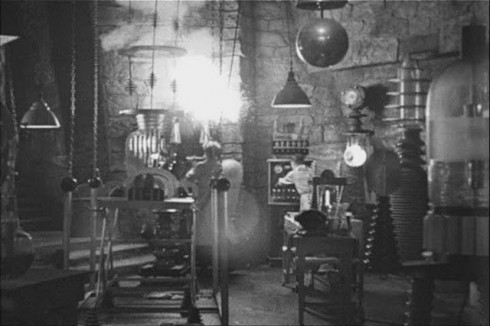
My suspicion, regarding today’s site instability, is that the server room where the page is dispensed from is simply lacking sufficient science-y props.
The necessary corrective measures are likely just some more Flash Gordon music, and a cluster of those lightning-orbs common to old horror flicks.
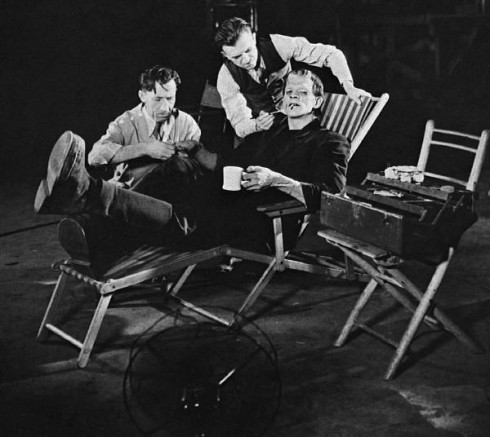
Speaking of which, I ran across some interesting tidbits regarding the classic Universal Frankenstein movie:
Kenneth Strickfaden designed the electrical effects used in the “creation scene.” So successful were they that such effects came to be considered an essential part of every subsequent Universal film involving the Frankenstein Monster. Accordingly, the equipment used to produce them has come to be referred to in fan circles as “Strickfadens.” It appears that Strickfaden managed to secure the use of at least one Tesla Coil built by the then-aged Nikola Tesla himself. According to this same source, Strickfaden also doubled for Karloff in the electrical “birth” scene as Karloff was deathly afraid of being electrocuted from the live voltage on the stage.
My advice for the mad scientists feverishly attempting to re-stabilize the beast is thus: sometimes fire isn’t the right approach; sometimes you need to pamper the monster.