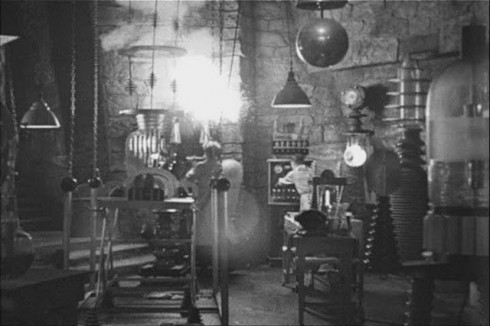
My suspicion, regarding today’s site instability, is that the server room where the page is dispensed from is simply lacking sufficient science-y props.
The necessary corrective measures are likely just some more Flash Gordon music, and a cluster of those lightning-orbs common to old horror flicks.
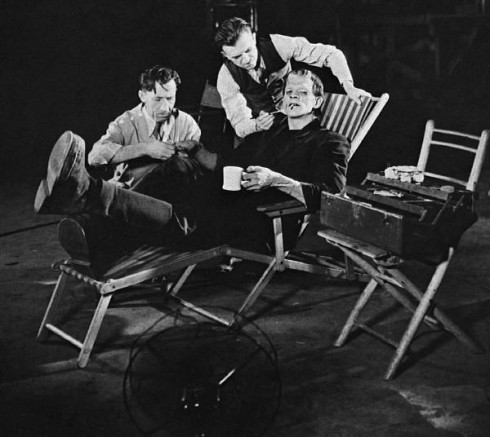
Speaking of which, I ran across some interesting tidbits regarding the classic Universal Frankenstein movie:
Kenneth Strickfaden designed the electrical effects used in the “creation scene.” So successful were they that such effects came to be considered an essential part of every subsequent Universal film involving the Frankenstein Monster. Accordingly, the equipment used to produce them has come to be referred to in fan circles as “Strickfadens.” It appears that Strickfaden managed to secure the use of at least one Tesla Coil built by the then-aged Nikola Tesla himself. According to this same source, Strickfaden also doubled for Karloff in the electrical “birth” scene as Karloff was deathly afraid of being electrocuted from the live voltage on the stage.
My advice for the mad scientists feverishly attempting to re-stabilize the beast is thus: sometimes fire isn’t the right approach; sometimes you need to pamper the monster.
Last night the server apparently caught a case of the fall-overs, but, fearless chrononaut RetroJim, of Relic Radio, has applied the proper whips to the proper galley slaves, and everything seems to be back to normal.
While I’ve got your attention, however, I’d like to point out that friend of the site, Barry/BMJ2k, is celebrating his 500th post over at Mr Blog’s Tepid Ride (http://bmj2k.com) – why not swing by and let him know how much you appreciate his constant slaving over a hot keyboard?
When you get back from that, the final item I might point out is last night’s episode, #162: The Last Pilgrimage, which is 19% more epic than the usual Flash Pulp. As I’ve mentioned previously, by the time we post a story I’ve usually grown to hate some aspect of it – not so this time.
Tonight’s episode is brought to you by Jessica May’s birthday.
Happy Birthday, Mrs. President.
Flash Pulp is an experiment in broadcasting fresh pulp stories in the modern age – three to ten minutes of fiction brought to you Monday, Wednesday and Friday evenings.
Tonight, we bring you a fantastic tale of travels, beliefs, and works.
Flash Pulp 162 – The Last Pilgrimage, Part 1 of 1
Written by J.R.D. Skinner
Art and Narration by Opopanax
and Audio produced by Jessica May
On his eighteenth birthday, Muggon went on the pilgrimage. His eldest brother had long fancied the journey, but, by the time he’d reached a proper age for it, he’d already found himself wed by way of a squalling bairn.
In truth, when the boy first set from the smattering of sod huts that had made up his young life, he was little excited for the path ahead. He’d never thought it would come to his living upon the road, and he’d never dreamed higher than a plot of earth to scratch at, and a wife to help eat the returns.
Yet, there was no choice. The land had run dry, and seemed to devour the rain as it fell – it came to him to make the fool’s journey of finding a god to pray to.
Standing at the crest of Bigfall Hill, he ran his wrist across his nose, and blinked away the results of his final goodbyes. In the distance he could see his mother alongside his brother and new wife. Their arms had grown tired from waving his departure, but they once again raised their hands, knowing this was their final opportunity before the hill swallowed him from view.
He would miss them, but was glad they could not discern his tears.
They were not the only he’d spill in the next year, as each inn and camp reeked of rumour without substance. Most had some word to impart of the gods, there were even those amongst the eldest who claimed to have been in the presence of one in their youth, but all provided directions based on a tale overheard by an cousin’s acquaintance’s butcher’s nephew, each of forgotten name.
Once in the world, it was tempting to drift into a new existence, but he inevitably found there was only a cold welcome for a wandering man of few means, and his experience came hard won. Two months after the first time he’d laid with a woman, and two-months-one-day after he’d first been forced to kill in self-defense, he met a trader who’d come from the Northlands of Dund.
The man wielded a beard of immense size, and his cloak looked as if every meal he’d ever trapped and eaten had been incorporated into its makeup.
“Yes,” he said, “I’ve seen the column with my own eyes. Three seasons ago I decided to ride hard south – there’s more demand where they’ve yet to be.”
“Do you know which it is?” asked Muggon.
The trader’s fingers disappeared within his riot of facial hair.
“Aggie The Sower.” he replied.
“Did… did you see any of his works?”
“Yes – hence why I’m here. The prayers of his pilgrims often leave all in better stead, not just the few. I’ve found when crops are plentiful and pantries are well stocked people’ve less interest in bargaining against my toothless scowl.”
To commemorate the event, Muggon purchased a small rattle from the merchant, hopeful that he would soon be home to share the bauble with his nephew.
As way of thanks, he did little haggling.
He’d heard of Aggie, often about the yearly fire on Bigfall Hill, on Dying Day, when the harvest was done and the spirits were said to roam. It was whispered that The Sower was one of the greatest of the gods, that his mighty fingers had once corrected the flow of waters as a child might alter a puddle to enhance the course of a twig-raft. From the hushed tones of friends and family, he had learned that the deity could see the future; could alter his size to such a proportion as to crush flat his hamlet of origin without thought; could even summon storms to shatter the landscape and drown any who did not believe in his supremacy.
These stories filled Muggon’s mind in the ninety days he spent overtaking his goal: the column.
A thousand souls shuffled, in packs, across the snow-dusted grass. He’d chased them from a place called Sur, whose inhabitants were still celebrating the return of a pilgrim of their own. Better still, to his ears, was the news that the god’s recent passing had been accompanied by the raising of a massive barn. The main-beam had been the heart of a thousand year old tree, and whose colossal girth had been set in place by Aggie’s hands, and his alone.
His third life began then – his plea was heard on the first day, but by those who acted as intermediaries. He was warned vehemently against approaching the gleaming saviour that lead the band, as any obstruction was ill regarded: each missed step was a delay not just from the current destination, but from all those beyond.
Order came from a council of sorts, comprised of those who’d furthest traveled, and some who had given up their prayers and sought only to continue the path of hardship, punctuated by celebration, that was the god’s shadow. Each sojourner knew their position, determined by the tasks necessary to reach their own home.
When Muggon first presented his request, he was informed after only a short time that he was five-thirty-seven. Unlearned in numbers, he hadn’t understood its meaning, but several moons upon the trek, and in the company of gamblers, taught him math and its uses, including the significance of the ever decreasing number that was his place in the sequence of works.
Arithmetic was not all, however. At each stop, it seemed he learned some new skill necessary to aid the pilgrim that had beseeched The Sower for assistance, so that the journey might be expedited. He learned of tillage, and animal husbandry, and the natural medicines. The god’s commands were law, and Aggie instructed his followers to their own best advantage.
Uncounted years later, while restoring a tower of ancient provenance – a structure that would allow great vantage for the onset of fires which ravaged the area each fall – Muggon was informed of news he’d been longing to hear.
“Three,” said Gon, his oldest friend. The speaker cleared his throat before adding, “but – The Sower has requested your presence.”
The news explained why the messenger had not grinned to bare the anticipated dispatch.
Muggon ran to respond.
In recent months the god had grown quiet in its march, and this newest summons did not seem to bode well to his disciple.
As was customary for private conversation, the column had fallen back some way, allowing the pilgrim to tread alone with his lord.
As he spoke, Aggie’s voice held crisp surety – as always.
“Jesus, man, you really came from the middle of nowhere. I figure we’ll be be two month’s over the average job completion time, and that’s just to get there.”
“I apologize!” Muggon replied, his lips pale.
“Relax, relax. Listen, the old atomic ticker’s only got about that long anyhow. We’re gonna make a run for your place, but I don’t know how much use I’m going to be once we get there.”
“I don’t understand?”
“What I’m trying to tell you is that I’ve only got enough juice left for a few more jobs, then it’s off into the sunset with me. Only so much one farm-bot can do, even in days like these. Sure been a pleasure helping you folks, though. Now, your the brightest lad I’ve seen in a while, and I figure the best thing doing at this point is to talk out your problem, see where you’re at, then I might be able to teach you how to fix it yerself.”
It took Muggon a moment to dissemble his saviour’s dialect, but, realizing what was being asked, he was pleased to finally have an opportunity to speak his prayer directly.
“The land about my people’s homes is barren. Please, have mercy, bring us water.”
“Yeah, yeah, got some rivers near by? Guess a lake is too much to hope for? What’s the water table like? You know what to watch for, for that sort of thing?”
What came next was a tutorship as rarely received. In the months that followed, Muggon’s mind was filled with every category of practical learning that had been otherwise forgotten. The first matter was the written word, as without it the man knew his mind could never contain the breadth and depth of the flow that overcame him.
He wrote the history of a terrible plague, and the savage madness that arose in its wake. He devised a calender, to Aggie’s specifications, and he charted many stars and their seasonal significances.
As his skills grew, he recounted the final pair of heroic acts carried out by The Sower. The first was the purification of a well by way of removal of poisons from within the turf – a feat which had required the construction of massive earthworks, and the transference of an artifact to an enclosed crypt, now posted with a warning to never again breach the seal, under dire consequence.
The second was establishing a standing orchard of many thousand trees, all with the intention of providing fruit which might curtail a terrible illness of nutrition which had befallen the inhabitants of the surrounding countryside. The time taught Muggon much about the rudimentaries of genetics, and the splicing and tending of timber.
In the end, The Sower made it as far as Bigfall Hill. He’d been busy imparting minutia regarding algebraic geometry, and his eager student, with his eyes and quill upon homemade parchment and makeshift tablet, had not recognized the approach as any different than the thousand such he’d seen before. It was only at the peak, with the village spread before him, that he realized he’d arrived.
It was Aggie who broke the silence.
“Well, Pard, this is my stop. Like I said, you ever happen to run by a Hokkaido Electric TU-13 power cell, feel free to run it on by. It’s an easy install, goes right in my mouth. Pop it down the chute and the internals’ll take it from there. Otherwise, think I’ll just take a rest – you though, better get cracking on that irrigation system. Won’t be nothing but kids play for ya.”
They were the god’s closing words. In the years to come, children would play at Aggie’s feet, and each Dying Day the still figure would stand guard at the edge of the fire, as the tales of The Sowers’ undertakings were told.
First, though, for the pilgrims, came mourning – and then, heeding their master’s last command, the work.
Muggon was happy to finally deliver the rattle he’d bought so many years previous, even if it was to his brother’s seventh-born. He was pleased too, to see how the people had fared, even under such circumstances. When the final strut was built, and the flow of nourishment redirected to flood the farmers’ thirst, he beamed with the knowledge that they would now prosper. Even with his labour, there was time for tale telling, and to teach his brother some of what he’d learned upon the road: of numbers, and barn raising, and tonics.
Then he’d stood to leave.
He did not cry this time – he knew he must find the holiest of relics, the battery of resurrection, and that, as he moved across the land, he must spread the wisdom of Aggie and the book of The Sower.
The column followed.
Flash Pulp is presented by http://skinner.fm, and is released under the Canadian Creative Commons Attribution-Noncommercial 2.5 License.
Text and audio commentaries can be sent to skinner@skinner.fm, or the voicemail line at (206) 338-2792 – but be aware that it may appear in the FlashCast.
– and thanks to you, for reading. If you enjoyed the story, tell your friends.
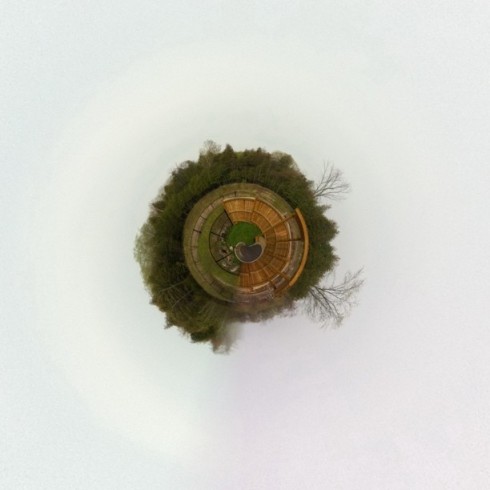
As part of Jessica May’s birthday celebration, we held a small blaze in our freshly constructed backyard fire-pit. Standing at the flame’s edge, my mind wandered back to the last time we’d had such a gathering: at our old place of residence, a year, and a lifetime, ago.
The momentum of memory didn’t stop there, however. I recalled the summer evenings, in my youth, when I would listen to the flat and broken tones of my grandfather, singing along to some maudlin cowboy tune while staring into the smoke and sipping at his hops. Then, further back, a recollection of my own father, before his death, stoking high the fire, and warning my seven-year-old clumsiness against getting too close.
Captured by the sequence, my mind’s eye went even beyond – to the tales of bushwhacking and lumber camps that my mother’s father had imparted from his own adolescence, and to the lonely embers my father’s father must have gathered about while still a boy himself, when the land had yet to be cleared for farming.
There are few common threads that run through the course of human history. If you were to present a bungalow, gas range, or memory-foam mattress, to a traveler from a previous age, they’d little understand their provenance – but, lead them to a simple fire, and they’d recognize an ageless, and universal, hospitality.
It was entirely my fault – I didn’t detect the odd background noise, and it was left up to our intrepid audio engineer to discover the error in my calculations.
Rather than pollute the feed with a crunchy episode, we’re going to hold off till tonight and re-record. The script is a little longer than usual, so hopefully it’ll be worth the wait.
It’s Jessica May’s birthday, which means today’s blogging will be rather random, and may involve epiphanies regarding cake.
For any who might be moved to do so, the best non-physical gift to give her would be to join the Flash Pulp Facebook page – her heart swells each time she sees it grow.
The upside is that #162 ought to be up quite early.
The various customs with which people today celebrate their birthdays have a long history. Their origins lie in the realm of magic and religion. The customs of offering congratulations, presenting gifts and celebrating – complete with lighted candles – in ancient times were meant to protect the birthday celebrant from the demons and to ensure his security for the coming year. . . . Down to the fourth century Christianity rejected the birthday celebration as a pagan custom.
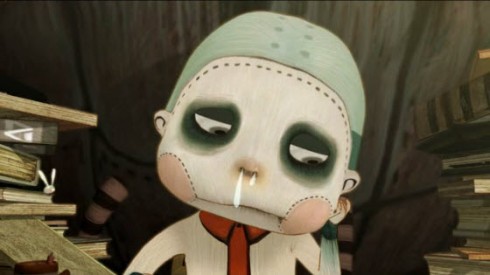
Tales of phlegm mites, tiny parasites mainly preoccupied with the consumption of mucus, are common in elementary classrooms. The problem is said to begin when a chronic nose-miner – the tales often use the name Katie or Kathy – unknowingly leaves a green deposit beneath their fingernail. At some point during the child’s muck-handed schoolyard explorations, the mites discover the tempting goo and dig in.
The trouble begins when the finger returns to her nostril.
The unfortunate goes to bed that evening complaining of a persistent itch, and her unsuspecting parents attempt to placate her with some nasal decongestant – unbeknownst to the family, the mites frenzy at the introduction of the chemicals, (and at their suddenly decreasing meal supply.) By morning the tiny insects have eaten through her flesh, creating a large, red and ragged gap.
In other versions of the story, the nose is consumed entirely, leaving only protruding bone.
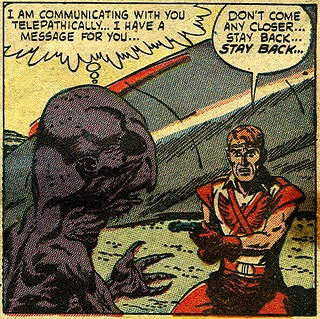
Hello, and welcome to FlashCast episode eighteen – prepare yourself for 50 foot mummies, Canadians in comics, St Stephen’s, the name game, and not episode 161.
If you have comments, questions or suggestions, you can find us at https://flashpulp.com, call our voicemail line at (206) 338-2792, or email us text or mp3s to skinner@skinner.fm.
FlashCast is released under the Canadian Creative Commons Attribution-Noncommercial 2.5 License.
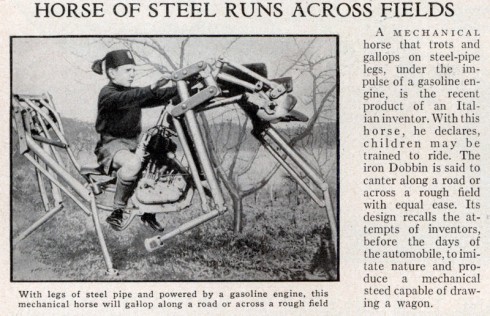
An excerpt from a 1933 issue of Popular Science: I have no idea if the beast actually worked – I suspect it did, but at a very slow pace. Still, you’ve got to admit that it looks neat, and that kid & his hat are the very portrait of gusto.
Roads be damned, I’d love to live in a world filled with nothing but airships and off-road mechanical horses.

 As part of Jessica May’s birthday celebration, we held a small blaze in our freshly constructed backyard fire-pit. Standing at the flame’s edge, my mind wandered back to the last time we’d had such a gathering: at our old place of residence, a year, and a lifetime, ago.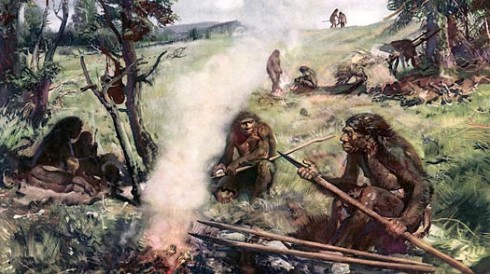


 The trouble begins when the finger returns to her nostril.
 [audio:http://traffic.libsyn.com/skinner/FlashCast018.mp3](
 I have no idea if the beast actually worked – I suspect it did, but at a very slow pace. Still, you’ve got to admit that it looks neat, and that kid & his hat are the very portrait of gusto.